
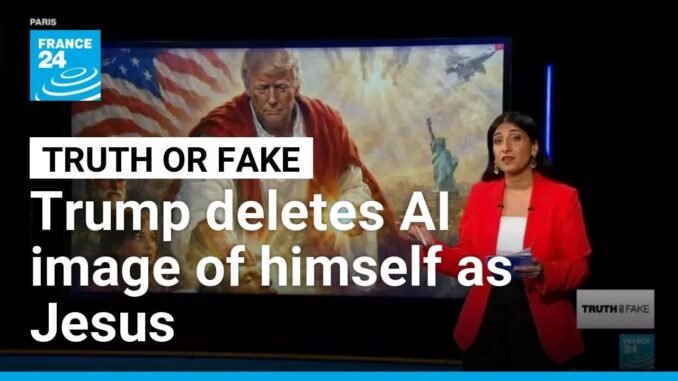

Summary: President Donald Trump deletes controversial AI-generated image depicting him as Christ after facing severe criticism from Christian leaders and commentators who called it blasphemous.
In a move that has sparked heated debates across social media and religious circles, U.S. President Donald Trump has taken down an artificial intelligence-generated image that portrayed him in a Jesus-like manner. The decision came after mounting pressure from Christian commentators and religious leaders who condemned the post as “blasphemous.”
The Controversial Image
The now-deleted image, which circulated widely on Trump’s social media platform Truth Social, showed the American president in a depiction reminiscent of religious iconography associated with Jesus Christ. The AI-generated artwork quickly drew the ire of Christian communities both within and outside the United States.
For many Nigerians, who hold their Christian faith dear with over 46% of the population identifying as Christians, such imagery strikes at the heart of deeply held religious convictions. The concept of comparing any political leader to the Saviour is considered not just inappropriate, but outright offensive to many believers.
Religious Leaders Speak Out
Christian commentators wasted no time in expressing their displeasure. Many described the image as crossing a sacred line, with some calling it an act of idolatry. The backlash was swift and widespread, cutting across denominational lines from evangelical circles to mainstream Christian communities.
“This is not about politics anymore; it’s about respecting the faith of millions,” one prominent Christian leader stated, echoing sentiments that have resonated with believers worldwide, including Nigeria’s vibrant Christian community.
Nigeria’s Perspective on Faith and Politics
In Nigeria, where religion plays a central role in public life and political discourse, such imagery would likely provoke similar, if not stronger reactions. Nigerians are known for their deep reverence for religious symbols and figures, regardless of political affiliation.
Pastor Chris Oyakhilome, Bishop David Oyedepo, and other Nigerian Christian leaders have consistently emphasized the importance of maintaining the sanctity of Christ’s image and teachings. The idea of a political figure being portrayed as Christ-like would undoubtedly generate significant controversy in Nigeria’s religious landscape.
The Power of AI in Modern Politics
This incident highlights the growing intersection of artificial intelligence, politics, and religion in the digital age. AI-generated images have become increasingly sophisticated and accessible, allowing for the creation of content that can blur the lines between political messaging and religious symbolism.
The controversy also raises questions about the responsibilities of political figures in the age of social media, where images can be created, shared, and go viral within minutes, potentially offending millions before they can be taken down.
Social Media Reactions
Nigerians on social media platforms, particularly Twitter (X) and Facebook, have been discussing the incident with characteristic candour. Many have drawn parallels to local political situations where leaders have been accused of messianic complexes or god-like self-presentations.
“We see this even here in Nigeria,” one social media user commented. “Politicians who want to be worshipped like deities. It’s wrong everywhere, whether in America or Africa.”
The Broader Context
This is not the first time Trump has faced criticism over religious matters. Throughout his political career, the former and current president has maintained a complex relationship with Christian communities, enjoying strong support from evangelical voters while occasionally drawing criticism for actions or statements deemed inconsistent with Christian values.
For Nigerian observers, the incident serves as a reminder of the delicate balance political leaders must maintain when engaging with religious communities. In a country where religious sensitivities run high and faith leaders wield considerable influence, such missteps can have significant political consequences.
Lessons for Political Leadership
The swift removal of the image suggests an awareness of the potential damage such controversies can cause. In Nigeria’s political landscape, where religious affiliations often influence voting patterns and public opinion, leaders must navigate religious sensitivities with care and respect.
As Nigeria approaches future election cycles, this incident from America offers valuable lessons about the importance of respecting religious boundaries in political communication, especially in an era where AI-generated content can quickly spiral out of control.
Moving Forward
While the image has been deleted, the conversation it sparked continues. The incident serves as a cautionary tale about the intersection of technology, politics, and religion in the 21st century—a conversation that resonates just as powerfully in Lagos and Abuja as it does in Washington D.C.
For Nigerian Christians and believers worldwide, the message remains clear: political leadership, regardless of how popular or powerful, must never cross the sacred boundaries of faith. The reverence for Christ and religious symbols transcends political allegiance, a principle that holds true from the streets of Jos to the halls of American power.
Be the first to comment