
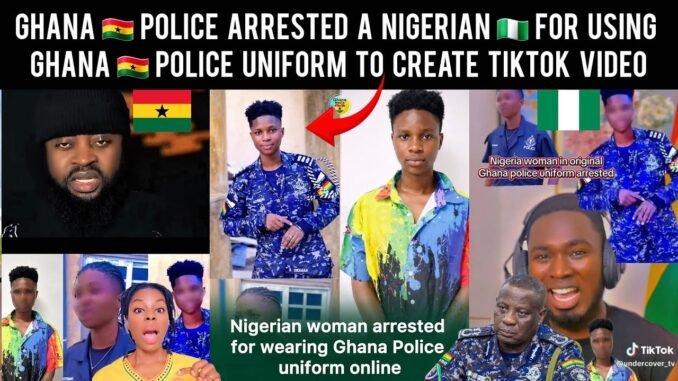

The Ghana Police Service has apprehended Esther Obasi, a Nigerian national, following her controversial appearance in official police uniforms on social media platforms.
The Incident That Sparked Outrage
Esther Obasi found herself in hot water after she posted videos showing herself dressed in both the official police camouflage and the standard black police uniform. The videos, which quickly circulated across various social media platforms, immediately raised red flags and caught the attention of Ghanaian law enforcement authorities.
Why This Matter Is Serious
Wearing police uniforms without authorization is not just a fashion statement gone wrong—it’s a serious criminal offense in Ghana and most countries, including Nigeria. Such actions can:
– Undermine public trust in law enforcement
– Create opportunities for criminal activities
– Compromise national security
– Lead to identity fraud and impersonation crimes
The Legal Implications
In Ghana, as in Nigeria, impersonating a police officer is a punishable offense under the law. The act of wearing official police attire without proper authorization can attract significant legal consequences, including imprisonment and hefty fines.
This case serves as a stark reminder to content creators and social media enthusiasts about the boundaries of creative expression, especially when it involves uniforms of security agencies.
A Growing Trend of Social Media Impersonation
This incident highlights a troubling trend among some social media users who wear uniforms of security agencies for content creation, often without understanding the legal ramifications. What might seem like harmless content creation or an attempt to gain followers can quickly escalate into a criminal matter.
Lessons for Social Media Users
For Nigerians and other nationals living in Ghana or creating content involving official uniforms:
1. Respect national symbols: Police and military uniforms are not props for entertainment
2. Understand local laws: What might be tolerated in one country could be illegal in another
3. Think before posting: Social media content has real-world consequences
4. Seek proper authorization: If your content requires official uniforms, get proper clearance
The Bigger Picture
As our fellow Nigerian faces legal proceedings in Ghana, this incident should serve as a wake-up call to content creators everywhere. The quest for viral content and social media fame should never cross the line into illegality.
The case of Esther Obasi reminds us all that creativity and content creation must be balanced with respect for the law and understanding of cultural and legal sensitivities, especially when living or creating content in foreign countries.
This is a developing story. More details will be provided as they become available.
Check buzzUp9ja fore more updates
Be the first to comment