
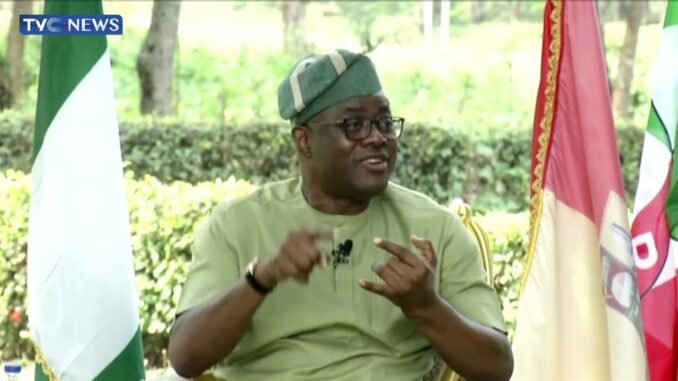

Governor Seyi Makinde of Oyo State has sounded a sobering alarm about the health of Nigeria’s democracy, cautioning that the nation may be slowly but steadily drifting towards a one-party state—a development that could undermine the very foundation of our hard-won democratic system.
The Peoples Democratic Party (PDP) governor shared his concerns in a recent newsletter aptly titled “The Bus,” where he painted a troubling picture of the current political landscape and what it means for ordinary Nigerians who have fought tirelessly to maintain democratic governance since 1999.
A Democracy Under Pressure
Makinde’s warning comes at a time when many Nigerians have expressed frustration with the state of political competition in the country. Since the transition to civilian rule over two decades ago, Nigeria has prided itself on being one of Africa’s largest democracies, with multiple political parties competing for power at various levels of government.
However, the governor’s concerns reflect a growing sentiment among opposition politicians and civil society groups that the playing field is becoming increasingly uneven, with one political party seemingly consolidating power across the federation.
Why This Matters to Every Nigerian
For the average Nigerian, the idea of a one-party state might seem like an abstract political concept. But the implications are very real and affect everyone’s daily life. A healthy democracy thrives on competition, checks and balances, and the ability of citizens to choose between different visions for the country’s future.
When one party dominates without meaningful opposition, several dangers emerge:
– Reduced accountability: Without strong opposition to question policies and decisions, the ruling party may become less responsive to citizens’ needs
– Limited policy alternatives: Different parties bring different solutions to Nigeria’s challenges—from security to economy to education
– Weakened institutions: Democratic institutions like INEC, the judiciary, and anti-corruption agencies may face pressure to serve partisan interests rather than national interests
– Citizen disengagement: When people feel their votes don’t matter or that the outcome is predetermined, they may stop participating in democracy altogether
The Historical Context
Nigerians who lived through military rule understand the value of political plurality. We remember when there was no room for dissent, when alternative voices were silenced, and when power was concentrated in the hands of a few. Our return to democracy in 1999 was meant to end all that.
Governor Makinde’s concerns echo the warnings of elder statesmen and pro-democracy activists who have repeatedly emphasized that democracy is not just about holding elections—it’s about ensuring those elections are genuinely competitive and that different political platforms have a fair chance to present their case to the Nigerian people.
What Political Observers Are Saying
Political analysts across Nigeria have noted the shrinking space for opposition politics in recent years. From defections of prominent politicians to controversies surrounding electoral processes, the signs that Makinde points to are visible to keen observers of Nigerian politics.
The governor’s position is particularly significant because it comes from someone who has successfully governed a major state and maintained his party’s hold despite national political headwinds. His perspective carries weight because he speaks from experience, not merely from the sidelines.
The Way Forward
While Makinde’s warning is sobering, it’s also a call to action for all stakeholders in Nigeria’s democratic project:
For citizens: Stay engaged, register to vote, and participate actively in the democratic process. Your voice matters, and surrendering to apathy only accelerates the drift towards one-party dominance.
For political parties: Opposition parties must strengthen their internal structures, present credible alternatives, and work together where necessary to protect democratic institutions.
For civil society: Continue to demand transparency, accountability, and fairness in electoral processes. The work of election monitoring and civic education remains crucial.
For democratic institutions: INEC, the judiciary, and security agencies must maintain their independence and ensure that all political parties compete on a level playing field.
A Democracy Worth Fighting For
Nigeria’s democracy, despite its imperfections, remains one of our most valuable national assets. It gives every Nigerian, regardless of background, a stake in how the country is governed. It allows for peaceful transfer of power and provides mechanisms for addressing grievances without resorting to violence.
Governor Makinde’s warning should not be dismissed as mere opposition politics. Rather, it should be seen as a patriotic concern for the future of our nation. History has shown that democracies don’t usually collapse overnight—they erode gradually, often while citizens are distracted by daily struggles for survival.
As Nigerians continue to grapple with economic challenges, security concerns, and social issues, the temptation might be to focus solely on immediate problems and ignore the slow erosion of democratic norms. But as Governor Makinde reminds us, the quality of our democracy determines our ability to address all these other challenges effectively.
The question now is: Will we heed this warning and take collective action to strengthen our democratic institutions, or will we wake up one day to find that the vibrant, multi-party democracy we once knew has quietly slipped away?
The answer lies not just with politicians but with every Nigerian who values freedom, choice, and the right to shape our collective destiny.
What do you think about Governor Makinde’s concerns? Is Nigeria truly drifting towards a one-party state, or is our democracy stronger than we think? Share your thoughts in the comments below.
Stay updated for more on buzzUp9ja
Be the first to comment