
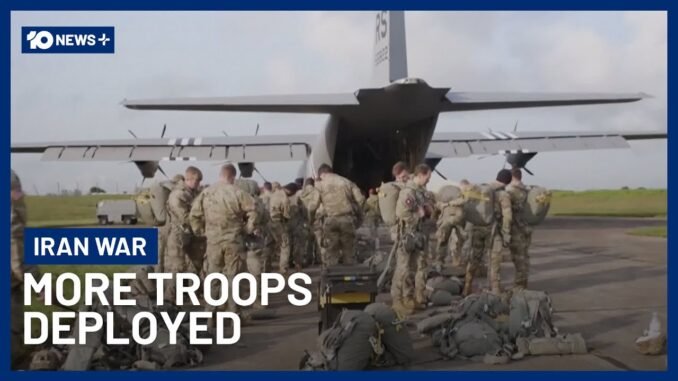

Summary: The US plans to deploy up to 4,000 more troops to the Middle East amid rising tensions with Iran. Learn what this military buildup means for Nigeria’s oil-dependent economy and global stability.
The United States is preparing to send thousands of additional soldiers to the Middle East in what appears to be a significant military buildup, even as the possibility of diplomatic engagement with Iran remains unclear.
According to international news agency Reuters, the Pentagon is planning to deploy between 3,000 and 4,000 troops from the elite 82nd Airborne Division. This specially trained unit, based at Fort Bragg in North Carolina, is renowned for its rapid response capabilities and can be mobilized within just 18 hours of receiving orders.
While the exact destination and timeline for this deployment have not been made public, military officials have indicated that the move is designed to enhance operational readiness for potential future actions in the region. However, they also stressed that no final decision has been made regarding sending troops into Iranian territory.
Nigeria’s Stake in Middle East Stability
For Nigeria, developments in the Middle East carry particular significance. As Africa’s largest oil producer and a member of OPEC alongside Iran, Nigeria’s economy is deeply connected to stability in global oil markets. Any escalation of tensions in the region—particularly around the Strait of Hormuz, through which about 21% of global petroleum passes—could send oil prices soaring.
While higher oil prices might seem beneficial for Nigeria’s oil revenues, economic experts warn that the volatility and uncertainty could actually harm the country’s fiscal planning and discourage foreign investment in the petroleum sector.
Massive Military Presence Already in Place
This latest deployment follows an earlier reinforcement that included U.S. Marines and sailors aboard the USS Boxer, an amphibious assault ship, along with its Marine Expeditionary Unit and supporting warships.
Even before these new deployments, the United States already maintained approximately 50,000 troops stationed across various Middle Eastern countries—a substantial military footprint that underscores American strategic interests in the region.
Strategic Targets Under Consideration
U.S. military planners have reportedly been examining several operational scenarios, including securing the strategically vital Strait of Hormuz and conducting potential operations along Iran’s coastline. Discussions have even included the possibility of targeting Kharg Island, a critical facility that handles the majority of Iran’s oil exports.
Such actions, if carried out, would have immediate and dramatic effects on global oil supplies and prices—a reality that would quickly be felt at Nigerian fuel stations and in the broader economy.
Diplomatic Signals Remain Mixed
Despite the increased military activity, the diplomatic picture remains murky. While some statements from U.S. leadership have suggested the possibility of constructive dialogue, Iranian officials have flatly denied that any talks are currently taking place.
This uncertainty is causing concern among international observers who fear that miscalculation could lead to wider conflict in an already volatile region.
American Public Opposition Growing
The potential deployment of ground troops—even in a limited capacity—carries significant political risks for the U.S. administration. Recent polling shows that a majority of Americans oppose military strikes against Iran, reflecting war-weariness after decades of involvement in Middle Eastern conflicts.
This domestic opposition may constrain how far American leaders are willing to go, though military preparations continue regardless.
What This Means for Nigeria
As Nigeria navigates its own security challenges—from insurgency in the Northeast to banditry in the Northwest—the country’s leadership will be watching Middle Eastern developments closely. Any major disruption to oil markets could impact the federal budget, which still relies heavily on petroleum revenues despite diversification efforts.
Moreover, as a non-aligned nation with relationships across multiple global powers, Nigeria may find itself navigating complex diplomatic waters if the situation escalates into broader regional conflict.
For now, Nigerians at home and abroad can only watch and hope that diplomacy will prevail over military confrontation in the Middle East.
Check buzzUp9ja for more details
Be the first to comment