
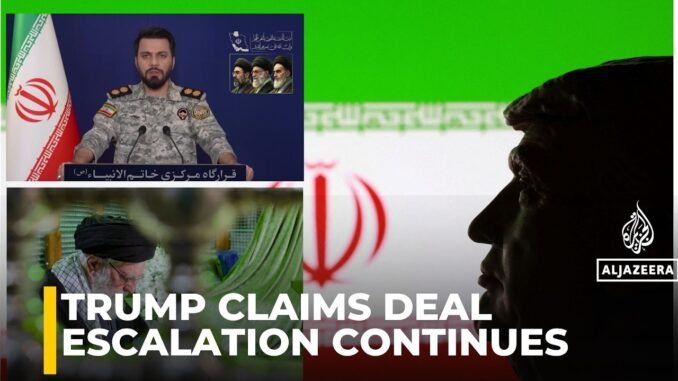

Summary: Iran’s military dismisses Donald Trump’s claims of ongoing negotiations while fresh airstrikes are exchanged with Israel. The Middle East conflict intensifies with no signs of de-escalation.
The already tense situation in the Middle East has taken another dangerous turn as Iran and Israel continue to exchange devastating airstrikes, while Iran’s military leadership has flatly rejected former U.S. President Donald Trump’s claims that peace negotiations are underway.
Iran Says “We’re Not Talking to America”
In a strongly worded statement that leaves no room for misinterpretation, Iran’s armed forces—controlled by the powerful Islamic Revolutionary Guard Corps (IRGC)—have dismissed any reports suggesting that Tehran is in talks with Washington. According to senior military spokesperson Ebrahim Zolfaqari, Iran has no intention of entering into any agreement with the United States, neither now nor in the foreseeable future.
Zolfaqari went as far as saying that Washington was essentially “negotiating with itself,” a phrase that highlights the deep mistrust between the two nations. This comes after reports emerged that the U.S. had presented a multi-point proposal to Iran aimed at calming the situation. However, Iranian officials argue that America’s track record during previous negotiations has destroyed any foundation of trust.
For those of us watching from Nigeria, this kind of diplomatic breakdown is familiar. Just as we’ve seen in regional conflicts closer to home, when trust collapses between nations, the consequences can be devastating for ordinary citizens caught in the crossfire.
The Fighting Continues to Intensify
While diplomats argue about who is talking to whom, the military confrontation on the ground tells a much clearer story—and it’s getting worse by the day.
The Israeli Defence Forces (IDF) have confirmed launching a fresh wave of airstrikes targeting key infrastructure in Tehran, Iran’s capital city. Worryingly, reports indicate that some residential neighbourhoods have been hit, with rescue operations still ongoing to pull survivors from the rubble. The human cost of these strikes is still being calculated.
Iran has not held back in its response. The country launched retaliatory attacks on several targets inside Israel, including the commercial hub of Tel Aviv and the northern town of Kiryat Shmona. But Iran’s response didn’t stop at Israel’s borders—Iranian forces also targeted American military installations in Kuwait, Jordan, and Bahrain, according to state-controlled media outlets.
Regional Neighbours Feel the Heat
The conflict is now directly affecting neighbouring countries in the Gulf region. Authorities in both Kuwait and Saudi Arabia have confirmed that they successfully intercepted drone attacks, preventing what could have been catastrophic damage.
In one particularly concerning incident, a fuel tank at Kuwait International Airport caught fire following a drone strike. Fortunately, officials reported no casualties, but the incident demonstrates how this conflict is spilling beyond Iran and Israel’s borders, threatening the stability of the entire region.
For Nigeria and other African nations with citizens working in the Gulf states—particularly in countries like Kuwait, Saudi Arabia, and the UAE—these developments are more than just international news. Thousands of Nigerians live and work in these areas, and any escalation puts them at risk.
No End in Sight
Despite mounting casualties on both sides, increasing global economic pressure, and international calls for restraint, there are currently no clear signs that either Iran or Israel is prepared to back down. Both nations continue their sustained military offensives, with each strike seemingly answered by a counter-strike.
The rejection of diplomatic engagement by Iran’s military leadership, combined with the ongoing exchange of attacks, paints a troubling picture for the immediate future. Without dialogue and a genuine commitment to de-escalation, the region appears headed for an even more destructive phase of this conflict.
What This Means for the Global Community
This escalating confrontation between two major Middle Eastern powers has implications far beyond their borders. Oil markets remain jittery, global shipping routes through the Persian Gulf face potential disruption, and the humanitarian cost continues to mount.
For Nigeria, with our own security challenges and economic concerns, events in the Middle East serve as a reminder of how interconnected our world has become. Instability in that region affects fuel prices at home, impacts our diaspora community abroad, and demonstrates the critical importance of diplomatic solutions to international conflicts.
As this situation continues to unfold, the international community watches anxiously, hoping that cooler heads will eventually prevail before the conflict spirals into an even larger regional catastrophe.
This is a developing story. Updates will be provided as more information becomes available.
Check buzzUp9ja for more updates
Be the first to comment