
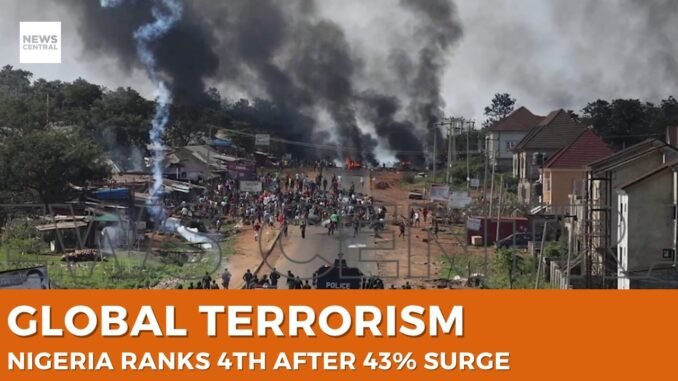

Summary: Nigeria’s terror crisis deepens as new Global Terrorism Index data reveals the country climbed to fourth place globally, with attacks increasing by 43% and fatalities reaching their highest since 2020.
Nigeria’s battle against terrorism has taken a troubling turn, with fresh global data painting a grim picture of our nation’s security challenges. The newly released Global Terrorism Index 2026 has ranked Nigeria as the fourth most terror-affected country in the world—a two-place jump that reflects the harsh reality many Nigerians, particularly in the Northeast, face daily.
The Alarming Numbers
The statistics are sobering and demand our urgent attention. In 2025, terrorist attacks across Nigeria surged by 43 percent, climbing from 120 incidents in 2024 to 171. Even more devastating, the number of lives lost increased by 46 percent to 750 fatalities—the highest death toll our country has witnessed since 2020.
These aren’t just numbers on a page. Behind each statistic is a Nigerian family torn apart, a community left traumatized, and a future cut short by senseless violence.
Borno State Remains Ground Zero
The burden of this terror crisis continues to fall disproportionately on our brothers and sisters in northeastern Nigeria, with Borno State bearing the heaviest load. This single state accounted for a staggering 67 percent of all terrorist attacks and 72 percent of total deaths in 2025, cementing its tragic position as the epicentre of insurgent activity in our nation.
While Nigerians in Lagos, Port Harcourt, and other southern cities go about their daily lives, families in Maiduguri, Gwoza, and surrounding communities live under constant threat—a reality that often feels invisible to the rest of the country.
Islamic State and Boko Haram: The Twin Menace
The driving force behind this violence remains familiar: Islamic State West Africa Province (ISWAP) and Boko Haram. Together, these extremist groups were responsible for approximately 80 percent of all terrorism-related deaths in Nigeria last year.
What’s particularly concerning is the rapid expansion of ISIS-linked operations. Attacks attributed to ISIS-affiliated groups jumped dramatically from just 20 in 2024 to 92 in 2025—a nearly five-fold increase that signals these terrorists are not only surviving but growing stronger and more organized.
Standing Alone in West Africa
Perhaps the most troubling aspect of this report is that Nigeria stands isolated in its struggle. While neighbouring countries in the Sahel region—including Burkina Faso and Niger—saw both attacks and fatalities decline, Nigeria was the only country in sub-Saharan Africa to experience increases in both categories.
This raises uncomfortable questions: Why are our neighbours making progress while we’re moving backward? What are they doing differently, and what lessons can we learn?
A Steady Climb Since 2022
The 2025 surge isn’t an isolated incident but part of a disturbing three-year trend. Terrorism-related deaths have been steadily rising since 2022, with 2025 alone recording 237 more fatalities than the previous year. This upward trajectory suggests that current counterterrorism strategies are failing to stem the tide.
Nigeria in Global Context
On the world stage, terrorism remains concentrated in just a handful of nations. Nigeria now finds itself in troubling company, grouped alongside Burkina Faso, Pakistan, Niger, and the Democratic Republic of the Congo—five countries that collectively account for 70 percent of all terrorism deaths worldwide.
While countries like Burkina Faso and Niger recorded significant declines in fatalities, Nigeria recorded the largest increase among this group, reinforcing international concerns about our deteriorating security situation.
Years of Military Operations, Yet No Breakthrough
Despite years of military campaigns, billions spent on security, and countless promises from successive administrations, Nigeria continues to rank among the world’s most terror-affected nations. We find ourselves listed alongside Pakistan and Somalia—countries that have become synonymous with security challenges.
This persistent crisis raises fundamental questions about the effectiveness of our approach. Are we addressing the root causes of extremism? Are resources reaching the right places? Are we learning from our mistakes and adapting our strategies?
The Human Cost Beyond Statistics
While global indices and rankings provide important context, the true measure of this crisis can’t be captured in spreadsheets. It’s found in the internally displaced persons camps across Borno, Adamawa, and Yobe states. It’s seen in the schools that remain closed, the farms that lie abandoned, and the economic potential that withers under the shadow of violence.
The Path Forward
As Nigeria continues to grapple with this security nightmare, several realities must be confronted:
First, military action alone hasn’t solved the problem. A comprehensive approach that addresses economic marginalization, education gaps, and community grievances is essential.
Second, the concentration of violence in the Northeast shouldn’t allow the rest of Nigeria to become complacent. This is a national crisis that demands national attention and resources.
Third, the rapid expansion of ISIS-affiliated groups suggests these organizations are adapting faster than our security responses. Intelligence gathering, community engagement, and regional cooperation must improve dramatically.
Finally, the success stories from neighbouring countries prove that progress is possible. Nigeria must swallow its pride, study what’s working elsewhere, and implement proven strategies.
A Call for Urgent Action
As we move deeper into 2026, the question facing Nigeria is simple but profound: Will we continue down this path of escalating violence, or will we finally summon the political will, strategic thinking, and national unity needed to turn the tide?
The 750 families who lost loved ones to terrorism in 2025 deserve better. The millions living under constant threat in the Northeast deserve better. Nigeria deserves better.
The time for excuses has long passed. The time for transformative action is now.
Visit buzzUp9ja for more details
Be the first to comment