
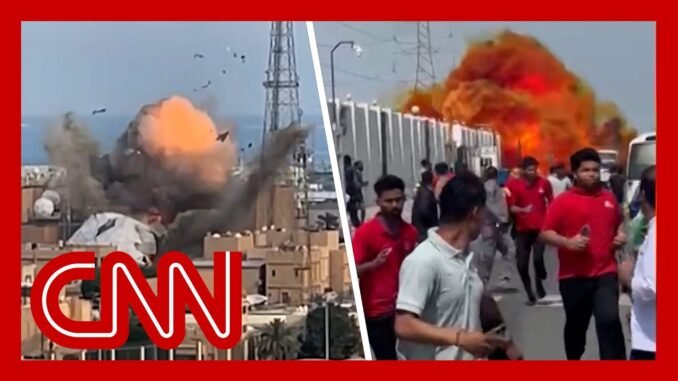

Summary: Iran has bombed multiple sites across the Gulf including US Navy headquarters in Bahrain following joint US-Israeli airstrikes, raising fears of a wider regional war in the Middle East.
The Middle East is on the brink of a full-scale regional war as Iran has launched a massive missile attack targeting American military installations across the Gulf, including the United States Navy’s Fifth Fleet headquarters in Bahrain.
This dramatic escalation comes hours after joint US-Israeli airstrikes pounded targets inside Iran, marking one of the most dangerous moments in the region’s recent history.
Bahrain Under Fire: US Naval Base Targeted
Authorities in the island kingdom of Bahrain confirmed that missiles struck near the US Navy’s Fifth Fleet headquarters located in the capital city, Manama. Residents reported hearing massive explosions across the city, followed by a towering column of black smoke rising into the sky.
The Fifth Fleet, stationed at Mina Salman base, serves as the command centre for all American naval operations throughout the Middle East and the Gulf region. While US officials acknowledged that infrastructure in Bahrain sustained damage, they have not confirmed whether the naval base itself suffered a direct hit.
According to NBC News, no American casualties have been reported so far, but the situation remains fluid and rapidly evolving.
Gulf States on High Alert: Travel Warnings Issued
As the crisis intensifies, the UK Foreign Office has issued an urgent warning to all British nationals living in or visiting the Gulf region. The advisory covers Bahrain, Kuwait, Qatar, and the United Arab Emirates.
The warning stated: “Due to reported missile attacks, British nationals in Bahrain, Kuwait, Qatar and United Arab Emirates should immediately shelter in place. Remain indoors in a secure location, avoid all travel and follow instructions from the local authorities.”
Several Gulf countries have responded by closing their airspace. The UAE, including the busy aviation hub of Dubai, has suspended all flights as authorities scramble to secure their territories against potential incoming missiles.
Casualties Reported Across the Region
The Iranian retaliation has not been limited to military targets. In Abu Dhabi, UAE, one person—identified as a Pakistani national—was killed when missile debris fell onto a residential neighbourhood, according to Sky News Arabia.
Explosions were also heard near Abu Dhabi’s main international airport, raising concerns about the safety of civilians in densely populated areas.
In Iraq, airstrikes killed at least two people in Jurf al-Sakhar, with several others seriously wounded. Reports suggest a missile also targeted the US Consulate in the northern city of Erbil, a key American diplomatic and military hub in Iraq.
Jordan, which maintains strong strategic ties with the United States, announced its military successfully intercepted two ballistic missiles that were heading toward the kingdom.
Israel on High Alert
Israel has placed the entire country on maximum alert, with warning sirens blaring across multiple regions. Israeli authorities have instructed all residents to seek shelter immediately as the threat of Iranian missile attacks looms large.
Embassies of various countries in Israel have urged their nationals to stay indoors and closely follow official guidance as the security situation deteriorates rapidly.
Iran Also Under Attack: Internet Blackout Reported
Meanwhile, fresh explosions have rocked Tehran and other Iranian cities following the earlier US-Israeli strikes. Hospitals across Iran are reportedly on standby to handle potential mass casualties.
The country is also experiencing a near-total internet blackout, a common tactic employed by the Iranian government during times of crisis to control information flow and prevent images and videos from reaching the outside world.
UK Government Responds: Cobra Meeting Expected
The British government has confirmed it played no role in the joint US-Israeli airstrikes on Iran. However, Prime Minister Sir Keir Starmer is expected to convene an emergency Cobra meeting to discuss the rapidly unfolding crisis and Britain’s response.
A UK government spokesperson emphasized the country’s commitment to preventing Iran from developing nuclear weapons while prioritizing the safety of British nationals in the region.
“Our immediate priority is the safety of UK nationals in the region and we will provide them with consular assistance, available 24/7,” the spokesperson said. “As part of our longstanding commitments to the security of our allies in the Middle East, we have a range of defensive capabilities in the region, which we have recently bolstered. We stand ready to protect our interests. We do not want to see further escalation into a wider regional conflict.”
What This Means for Nigeria and Africans in the Gulf
For Nigerians and other Africans living and working across the Gulf states—particularly in the UAE, Qatar, Bahrain, and Kuwait—this escalation presents serious safety concerns. Thousands of Nigerian professionals, domestic workers, and businesspeople reside in these countries.
The Nigerian government and embassy officials are yet to issue formal statements or evacuation plans, but Nigerians in affected areas are advised to:
– Stay indoors and avoid all unnecessary travel
– Keep emergency supplies of food, water, and medication
– Maintain contact with family members back home
– Monitor updates from the Nigerian embassies and consulates
– Follow all instructions from local authorities
– Keep passports and important documents readily accessible
A Region on the Edge
The tit-for-tat strikes between Iran and the US-Israel alliance represent the most serious military confrontation in the Gulf region in years. With multiple countries now directly involved and casualties mounting, fears are growing that the Middle East could be sliding toward a wider, more devastating war.
As the world watches nervously, the coming hours and days will be critical in determining whether diplomacy can pull the region back from the brink—or whether this marks the beginning of a broader conflict with global implications.
stay tuned on buzzUp9ja for more details
Be the first to comment