
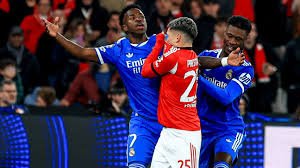

The global football community is buzzing with reactions after FIFA President Gianni Infantino called for immediate red cards for players who cover their mouths during on-pitch confrontations. This strong stance comes in the wake of racism allegations involving Real Madrid’s Brazilian superstar Vinícius Júnior.
The Incident That Sparked Global Outrage
During the Champions League playoff first leg match between Real Madrid and Benfica, Vinícius Júnior accused Benfica’s Gianluca Prestianni of racially abusing him. What made the incident particularly controversial was that Prestianni allegedly covered his mouth while making the offensive remarks—a gesture that has become increasingly common in modern football, but one that now faces serious scrutiny.
UEFA wasted no time in launching a formal investigation into the matter. Prestianni has been suspended for the second leg of the tie and could face up to a 10-match ban if found guilty by European football’s governing body. This is not the first time Vinicius Jr has faced racist abuse on the pitch, making this latest incident even more troubling for football authorities worldwide.
Infantino’s Hard Line Against Racism
Speaking to Sky News, the FIFA boss made his position crystal clear: “If a player covers his mouth and says something, and this has a racist consequence, then he has to be sent off, obviously.”
Infantino’s reasoning is straightforward and difficult to argue against. “There must be a presumption that he has said something he shouldn’t have said; he wouldn’t have had to cover his mouth,” he explained, adding that football authorities must acknowledge situations they “did not foresee.”
While maintaining that disciplinary cases require proper analysis and evidence, Infantino emphasized that the sport cannot simply be satisfied with current measures moving forward.
New Measures Coming Before 2026 World Cup
At Saturday’s International Football Association Board (IFAB) meeting, FIFA announced plans to introduce concrete measures ahead of the 2026 World Cup to prevent players from covering their mouths during confrontations.
Mark Bullingham, CEO of the English FA and IFAB member, supported the initiative, stating: “You can see when a player is talking to an opponent, there are very few circumstances where they should need when they’re confronting them to cover their mouth.”
These measures could potentially be agreed upon and implemented in time for this summer’s World Cup, with next month’s FIFA Congress in Vancouver serving as a crucial milestone for the proposal.
A Cultural Shift: Beyond Punishment
In a surprising twist, Infantino also advocated for a cultural change in how football handles disciplinary matters. Rather than focusing solely on punishment, he suggested creating opportunities for offenders to take public responsibility for their actions.
“Maybe we should also think about not just punishing, but also somehow allowing, changing our culture, allowing players or whoever does something to apologise,” Infantino proposed.
He explained that people can do things they regret in moments of anger, and if they apologise sincerely, “the sanction has to be different, to move one step further.”
Why This Matters for Nigerian Football Fans
For Nigerian football supporters who have watched our own players face similar challenges abroad, this development is particularly significant. The Super Eagles have produced countless talents who ply their trade in Europe, where racism remains a persistent problem despite numerous anti-racism campaigns.
The proposed measures represent a potentially powerful tool in combating racial abuse on the pitch. By removing the veil of secrecy that mouth-covering provides, authorities can better monitor and punish offensive behaviour.
The Road Ahead
Infantino concluded with a firm commitment: “These are actions that we can take, and we have to take in order to be serious about our fight against racism.”
As football continues to grapple with racism in 2025, these proposed changes signal that governing bodies are finally taking more decisive action. Whether these measures will prove effective remains to be seen, but the intent is clear: racism has no place in the beautiful game.
For Vinícius Júnior and countless other players who have suffered racist abuse, this represents a step in the right direction—one that could make the pitch a safer, more respectful environment for everyone who loves football.
—
What are your thoughts on FIFA’s proposed measures? Do you think automatic red cards for mouth-covering during confrontations will help combat racism in football? Share your views in the comments below.
For More Updates, Visit Buzzup9ja
Be the first to comment