
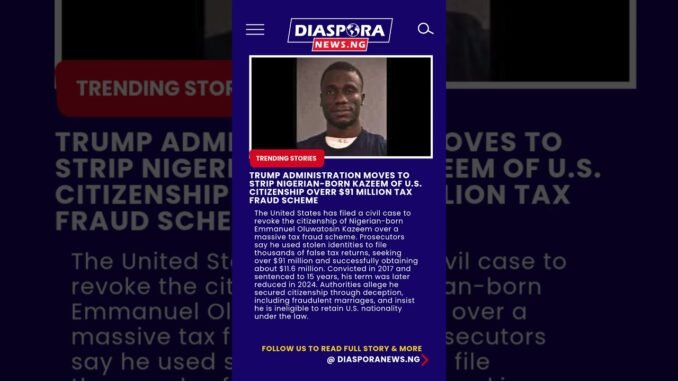

Summary: Emmanuel Oluwatosin Kazeem faces denaturalization after orchestrating a massive tax fraud scheme that targeted over 259,000 Americans and channeled millions to Nigeria.
The United States Department of Justice has initiated legal proceedings to revoke the American citizenship of Emmanuel Oluwatosin Kazeem, a Nigerian-born man who masterminded one of the most sophisticated tax fraud operations in recent U.S. history. The civil denaturalization complaint, filed in the U.S. District Court in Baltimore, Maryland, marks a significant escalation in the case that has already seen Kazeem serve prison time for his crimes.
The Fraud Empire That Shook America
Between 2012 and 2015, Kazeem built and operated a criminal network that would eventually compromise the personal information of more than 259,000 Americans. His operation was so extensive that it attempted to fraudulently claim over $91 million in tax refunds, successfully obtaining more than $11.6 million before authorities caught up with him.
The scheme’s sophistication was remarkable. Kazeem purchased over 91,000 stolen identities from a Vietnamese hacker who had breached an Oregon company’s database—a firm that ironically provided background checks for pre-employment and volunteer screening. With this treasure trove of personal information, including social security numbers and dates of birth, Kazeem organized his operation like a well-oiled business.
How the Operation Worked
Kazeem wasn’t working alone. He recruited and trained co-conspirators, including his younger brother, Michael Oluwasegun Kazeem, teaching them how to exploit vulnerabilities in the IRS system. The gang acquired over 19,500 Electronic Filing PINs, which allowed them to bypass authentication procedures designed to prevent exactly this type of fraud.
The conspirators used prepaid debit cards registered with victims’ stolen identities to receive direct deposits from the IRS. Once the money hit these cards, it was quickly withdrawn and transferred—often straight to Nigeria through wire services.
The Nigerian Connection
This is where the story hits particularly close to home for Nigerians. Over 2,000 wire transfers, totaling more than $2.1 million, were sent to Nigeria during the operation. Kazeem himself was directly linked to over 700 transfers worth more than $690,000.
What was he doing with all this money? Living large, both in America and back home. In the United States, Kazeem put down nearly $200,000 on a newly constructed house and purchased a $175,000 townhouse in Maryland. His monthly credit card bills averaged over $8,300—a lifestyle far beyond what his legitimate income could support.
But Kazeem had bigger dreams for Nigeria. He attempted to use his ill-gotten gains to develop a $6 million, four-star hotel in Lagos. It’s a painful reminder of how proceeds from international fraud often find their way back to Nigeria, fueling development projects built on criminal foundations.
The Unraveling
The scheme began to collapse in May 2013 when a couple in Medford, Oregon, discovered that fraudulent tax returns had been filed using their personal information. The IRS investigation that followed was extensive, involving search warrants executed in Illinois, Maryland, and Georgia.
When federal agents raided these locations, they found the physical evidence of the operation: approximately 150 prepaid debit cards at a Chicago residence along with $50,000 in money orders. In Maryland and Georgia, they seized more than 50 electronic devices, 40 money orders worth over $29,000, $14,000 in cash, and numerous prepaid cards loaded with over $12,000 in fraudulent refunds.
In 2017, Kazeem was convicted on 19 counts including mail and wire fraud, aggravated identity theft, and conspiracy. He received a 15-year prison sentence and was ordered to pay more than $12 million in restitution.
The Controversial Clemency
Here’s where the story takes an interesting turn. In December 2024, then-President Joe Biden commuted Kazeem’s sentence as part of a mass clemency action that affected nearly 1,500 individuals. These were people who had been serving under house arrest following their release from prison due to COVID-19 pandemic conditions. After serving only six years of his 15-year sentence, Kazeem walked free.
This clemency decision has now become a focal point of controversy, with the current administration using it to justify their aggressive pursuit of denaturalization.
The Denaturalization Case
The newly filed complaint alleges that Kazeem obtained his U.S. citizenship through fraudulent means. According to the Justice Department, his fraud scheme—which he committed both before and after his naturalization—along with his concealment of these crimes, meant he was never entitled to become a U.S. citizen in the first place.
But there’s more. The complaint also alleges that before his tax fraud operation, Kazeem engaged in a sham marriage to obtain permanent resident status, and then married a second woman. These actions, the government argues, further disqualified him from naturalization.
“The Trump Administration will not permit wrongdoers to retain the U.S. citizenship that they were never entitled to in the first place,” said Assistant Attorney General Brett A. Shumate. “U.S. Citizenship is a privilege, and we will continue to ask courts to revoke a status that was obtained through fraud and deceit.”
What This Means for Nigerians
This case serves as a stark warning to Nigerians in the diaspora about the severe consequences of engaging in fraudulent activities abroad. The tentacles of international law enforcement are long, and the penalties extend beyond prison time to potentially losing citizenship and facing deportation.
For law-abiding Nigerian immigrants pursuing the American dream through legitimate means, cases like this create additional scrutiny and unfortunate stereotypes that affect entire communities. It’s a reminder that the actions of a few can impact the reputation of many.
The case also highlights the ongoing challenge Nigeria faces with its international image regarding cybercrime and fraud. While the vast majority of Nigerians are honest, hardworking people, high-profile cases like Kazeem’s reinforce negative perceptions that the country has been fighting to overcome.
The Legal Battle Ahead
Kazeem now faces a legal battle that could result in the loss of his U.S. citizenship. If the denaturalization is successful, he would likely face deportation to Nigeria. The case is being handled by the Department of Homeland Security’s Homeland Security Investigations unit and will be prosecuted by the Affirmative Litigation Unit of the Civil Division’s Office of Immigration Litigation.
The investigation that led to Kazeem’s criminal conviction was a joint effort involving multiple federal agencies, including IRS-Criminal Investigation, the FBI, the U.S. Department of Health and Human Services, and the U.S. Department of State.
Lessons and Reflections
As Nigerians, we must confront uncomfortable truths about cases like this. While we rightfully celebrate our people’s success abroad, we cannot ignore or excuse those who choose the path of crime. The $2.1 million wired to Nigeria from this scheme represents stolen money that victimized ordinary Americans—people who may have had their tax refunds delayed or denied because of identity theft, who spent countless hours cleaning up their credit records, and who lost trust in systems designed to serve them.
The attempted hotel development in Lagos, funded by fraud, symbolizes a broader issue: how do we ensure that investments and developments in Nigeria are built on legitimate foundations? How do we create an environment where young Nigerians see more opportunity in honest enterprise than in sophisticated fraud schemes?
As this case proceeds through the courts, it will be watched closely by immigration advocates, civil rights organizations, and communities affected by both tax fraud and aggressive denaturalization policies. Whatever the outcome, Emmanuel Oluwatosin Kazeem’s story stands as a cautionary tale about the ultimate price of choosing crime over honest living—a price that extends far beyond any prison sentence.
For more updates, check buzzUp9ja
Be the first to comment