
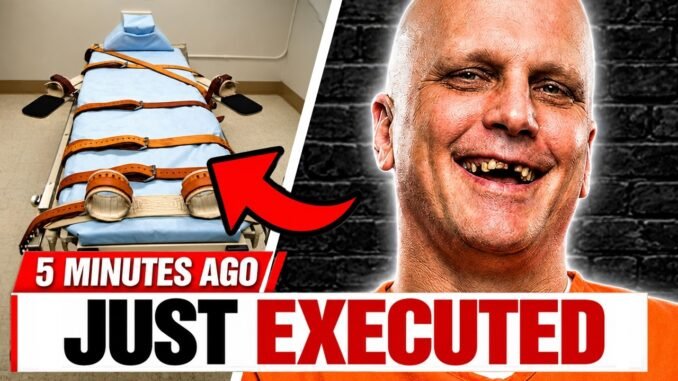

> A chilling case that raises deep questions about justice, mental health, and the purpose of capital punishment — James Robertson, 63, was executed in Florida after deliberately killing his cellmate to secure a death sentence.
—
In a case that has left many legal experts and human rights advocates deeply unsettled, the state of Florida has carried out the execution of 63-year-old James Robertson — a man who, by his own admission, took the life of his cellmate with one calculated goal in mind: to be sentenced to death.
A Deliberate Path to the Execution Chamber
Unlike most death row cases where the condemned fights tooth and nail to escape the lethal injection, Robertson’s story runs in the complete opposite direction. This man wanted to die — and he engineered a murder specifically to make that happen.
Robertson was put to death via a three-drug lethal injection, meeting the very end he had reportedly sought through such a disturbing and calculated act. His cellmate, an innocent man simply serving his own sentence, paid the ultimate price for Robertson’s dark ambition.
The Bigger Questions This Case Raises
For Nigerians who follow international justice matters — and let’s be honest, cases like this have a way of sparking serious owambe conversations and Twitter debates — this story opens a can of worms that goes far beyond Florida’s prison walls.
First, the mental health angle. Any person who kills another human being simply to receive a death sentence is clearly operating under enormous psychological distress. Yet, the system processed him, tried him, and executed him. Where does justice end and vengeance begin?
Second, the question of complicity. By granting Robertson exactly what he wanted, did the state of Florida ultimately serve justice — or did it simply fulfil the wishes of a disturbed individual?
Third, the value of life. Robertson’s cellmate never got a say. He lost his life not because of any conflict, rivalry, or even passion — but because he happened to share a cell with someone who had already decided to die and needed a means to that end.
What This Means in the Broader Conversation
Back home in Nigeria, where debates around the death penalty remain very much alive — with many states still having capital punishment on the books — cases like Robertson’s remind us that the justice system is never as straightforward as we might hope.
The death penalty is often presented as the ultimate deterrent. But what happens when someone wants it? When the punishment becomes the goal rather than the consequence?
These are not just American problems. They are human problems — questions about how societies handle broken minds, desperate souls, and the irreversible weight of taking a life.
Final Thoughts
James Robertson is gone now, at 63, having gotten precisely what he set out to get. Whether that represents justice, tragedy, or both simultaneously depends entirely on where you stand.
But one thing is certain — the cellmate he killed deserved far better than to become a footnote in someone else’s death wish.
That is the story we should never lose sight of.
—
What are your thoughts on capital punishment and cases like this? Drop your comments below and let’s have the conversation.
Want more details? check buzzUp9ja
Be the first to comment