
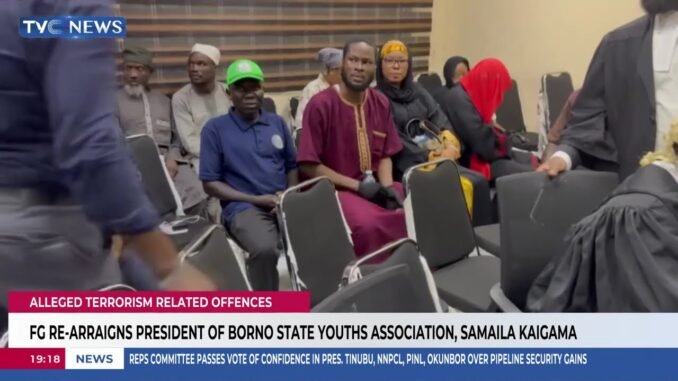

A Borno State youth leader is back in the dock as the DSS intensifies its crackdown on alleged terror collaborators in Nigeria’s troubled Northeast.
The Department of State Services (DSS) has once again brought Samaila Kaigama before the Federal High Court in Abuja, rearraigning him on serious allegations bordering on aiding Boko Haram and the Islamic State West Africa Province (ISWAP) — two of the most dreaded terror groups currently wreaking havoc across Nigeria’s Northeast region.
Who Is Samaila Kaigama?
Kaigama is a youth leader from Borno State — a state that has for over a decade been at the epicentre of Nigeria’s brutal insurgency crisis. His position as a youth figure makes the allegations against him particularly alarming, raising fresh concerns about how deep terror networks may have penetrated communities in the Northeast.
What Are the Allegations?
According to the DSS, Kaigama is accused of:
– Providing support and assistance to Boko Haram terrorists
– Alleged involvement in ransom collection — a common revenue stream used by terror groups to fund their deadly operations across the Lake Chad Basin
These are not allegations to be taken lightly. Terrorism charges in Nigeria carry some of the heaviest legal consequences under the Terrorism (Prevention and Prohibition) Act.
Why This Case Matters to Nigerians
For millions of Nigerians — especially those in Borno, Yobe, and Adamawa states — the insurgency is not a distant news headline. It is a daily, lived reality. Communities have been displaced, families torn apart, and livelihoods destroyed by years of Boko Haram and ISWAP violence.
Cases like this serve as a stark reminder that the fight against terrorism is not only fought on the battlefield. It is also fought in courtrooms, communities, and within the very social structures that are meant to protect young Nigerians.
The rearraignment signals that the DSS is pushing forward with its case, and Nigerians will be watching closely to see how the Federal High Court in Abuja handles the proceedings.
The Bigger Picture
Nigeria’s security agencies have ramped up efforts in recent times to prosecute individuals allegedly collaborating with terror groups from within civilian populations. The DSS, alongside the Nigerian Army and other security outfits, continues to stress that no one who aids terrorism will escape justice — regardless of their social standing or community position.
As the case progresses, it will serve as a critical test of Nigeria’s judicial system and its commitment to dismantling the networks that continue to fuel insecurity in the Northeast.
Stay with us for updates as this story develops.
For more information, check buzzUp9ja
Be the first to comment