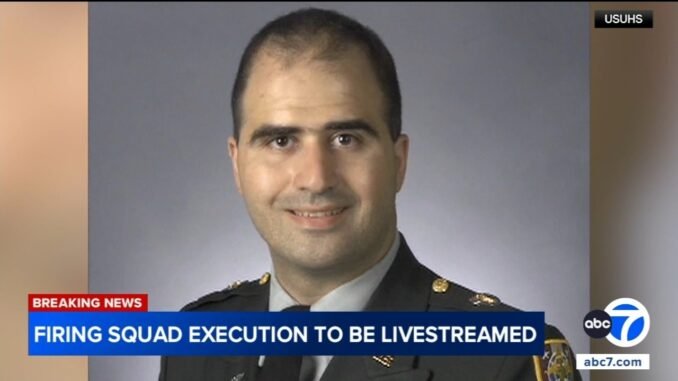

Summary: The Pentagon has confirmed plans to livestream the firing squad execution of Nidal Malik Hasan, the soldier behind the deadly 2009 Fort Hood shooting — marking a historic first in US military justice.**
The United States military is preparing to make history in a way that has set tongues wagging across the globe — and trust us, this one is not your regular breaking news.
The Pentagon has officially confirmed that the execution of Nidal Malik Hasan* — the man behind the deadly 2009 mass shooting at Fort Hood Army base in Texas — will be *broadcast live via firing squad. This will mark the first time in modern history that a US military execution will be livestreamed for public viewing.
Who Is Nidal Malik Hasan?
For those who may not be familiar with the story, Nidal Malik Hasan was a US Army Major and psychiatrist who, on November 5, 2009*, opened fire on fellow soldiers and civilians at Fort Hood, one of America’s largest military installations. The attack claimed *13 lives and left more than 30 others wounded before Hasan was shot and subdued by military police.
He was later convicted by a military court-martial in 2013 and sentenced to death — making him the first US soldier to receive a death sentence in decades.
Why Is This a Big Deal?
E be like say America don finally decide say enough is enough.
The decision to livestream the execution is unprecedented. In a country where capital punishment proceedings are typically shrouded in secrecy and restricted media access, throwing open the cameras for the world to watch marks a dramatic — and controversial — shift in approach.
The Pentagon’s move has sparked fierce debate both domestically and internationally. Some see it as a bold statement of military justice and accountability. Others are raising serious ethical questions about whether broadcasting an execution crosses a line into something that belongs in the Dark Ages.
What Nigerians Should Know About This
Here in Nigeria, we are no strangers to debates around justice, capital punishment, and how societies choose to handle their most heinous criminals. From the controversies surrounding executions carried out by state governments to ongoing discussions about justice reform, the question of how a society punishes its worst offenders is one that hits close to home.
The American decision raises questions that are equally relevant to us:
– Does public execution serve as a deterrent, or does it simply satisfy a hunger for revenge?
– Should the families of victims have a right to witness justice being carried out?
– Where is the line between transparency in governance and the dignity of human life — even that of a convicted killer?
The Broader Conversation
Whether you support the death penalty or not, one thing is clear — this event will spark a global conversation about justice, accountability, and the role of media in the modern age.
For a country like the US, which often positions itself as a beacon of human rights on the world stage, the decision to put an execution on live broadcast is a significant moment — one that many nations, including Nigeria, will be watching closely.
As the date of the execution draws near, expect international media to be buzzing. And you can be sure that Nigerians on Twitter — sorry, X — will have plenty to say when it finally happens.
Stay with us for updates as this story develops. Drop your thoughts in the comments — do you think livestreaming an execution is justice or just spectacle?
For more information, check buzzUp9ja
Be the first to comment