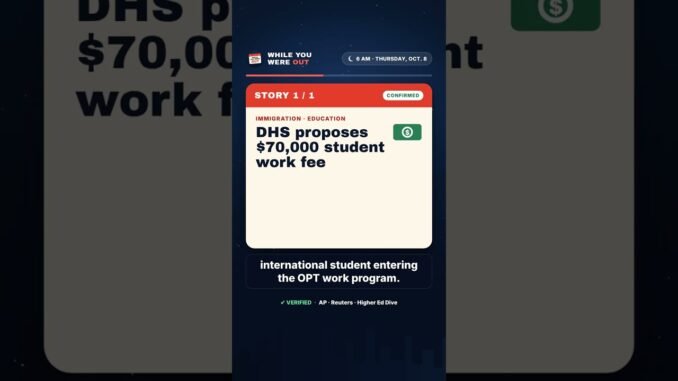

Summary: The US government is proposing a massive $70,000 fee for international students on OPT work programmes. Here’s what every Nigerian student and parent needs to know.
For many Nigerian families, sending a child to study in the United States is the ultimate investment — years of sacrifice, hustle, and prayers packed into one dream. But a jaw-dropping new proposal from the American government could make that dream significantly harder — and far more expensive — to pursue.
The US Department of Homeland Security (DHS) has proposed a staggering $70,000 fee* for international students, including Nigerians, who wish to work in the United States through the *Optional Practical Training (OPT) programme — a work authorisation scheme that allows international graduates to gain hands-on experience in their field of study after completing their degrees.
What Is OPT and Why Does It Matter to Nigerians?
If you have a sibling, cousin, or friend studying in America, chances are you’ve heard about OPT. It is essentially a lifeline for international students — a legal pathway that allows them to stay and work in the US for up to 12 months* after graduation, or up to *36 months for those who studied STEM (Science, Technology, Engineering, and Mathematics) courses.
For many Nigerian graduates in America, OPT is not just a career opportunity — it is the bridge between their student visa and a more permanent work arrangement. It gives them the chance to secure employment, build their résumé on American soil, and potentially qualify for an H-1B work visa down the line.
In short, OPT is one of the most critical steps in the Nigerian student’s American dream journey.
The $70,000 Bombshell
Now, the DHS wants to attach a $70,000 price tag to this opportunity.
To put that into perspective, that is roughly ₦115 million at current exchange rates — an amount that would make even the most comfortable Nigerian family pause and rethink everything.
This proposed fee would be a dramatic departure from the current system, where OPT application fees are relatively modest. Critics have already described the proposal as effectively pricing out students from developing nations, with Nigerians and other African students among those who stand to be hit hardest.
“After All the School Fees, Now This?”
Many Nigerians who study in the US already bear enormous financial pressure. Tuition alone at American universities can run into tens of thousands of dollars annually, and most international students are not eligible for federal financial aid. Families back home in Lagos, Abuja, Port Harcourt, and beyond often go to extraordinary lengths — selling property, taking loans, pooling family resources — just to keep their children in school.
The prospect of an additional $70,000 fee simply to work after graduation could render the entire investment pointless for many.
As one would say on the streets of Lagos: “You don chop the soup, now dem wan collect the pot too.”
Who Is Behind This Proposal and Why?
The proposal comes amid a broader crackdown on immigration under the current US administration, which has been pushing policies aimed at reducing the number of foreign nationals working in America. Supporters of the fee argue it would protect American jobs and ensure that only the most committed — and financially capable — international students remain in the country post-graduation.
However, critics, including university administrators and immigration advocates, argue that the proposal is short-sighted and counterproductive*. International students, they point out, contribute billions of dollars to the US economy annually, and many go on to *build companies, create jobs, and drive innovation in America.
Nigeria, it is worth noting, consistently ranks among the top African countries sending students to the United States, with thousands of Nigerian students enrolled in American institutions each year.
What Happens Next?
The $70,000 OPT fee is currently a proposal*, meaning it has not yet been signed into law. It will go through a review and public comment process before any final decision is made. However, given the current political climate in the US, many immigration experts are urging Nigerian students and families to *take this seriously and plan accordingly.
If you or someone you know is currently studying in the US, or planning to, here is what you should do:
– Stay informed — follow credible immigration news sources and consult a licensed US immigration attorney
– Explore alternatives — look into other post-study work options, including opportunities in Canada, the UK, or other countries with more favourable international student policies
– Join advocacy efforts — several student and diaspora organisations are already pushing back against this proposal; your voice matters
The Bigger Picture for Nigeria
This development is yet another reminder of why Nigeria must urgently invest in its own educational and economic infrastructure. When our brightest minds are forced to journey thousands of miles just to find opportunity — and then face walls even there — it speaks to a deeper problem that no amount of overseas hustle can fully fix.
The Nigerian government, universities, and private sector must work together to create an environment where a young graduate from the University of Lagos or Ahmadu Bello University can build a world-class career right here at home — without needing to pay $70,000 to anyone for the privilege.
Until then, the struggle continues — and Nigerian families deserve to know exactly what they are up against.
Stay updated on the latest news affecting Nigerians at home and in the diaspora. Share this article with anyone who needs to see it.
Stay updated — visit buzzUp9ja
Be the first to comment