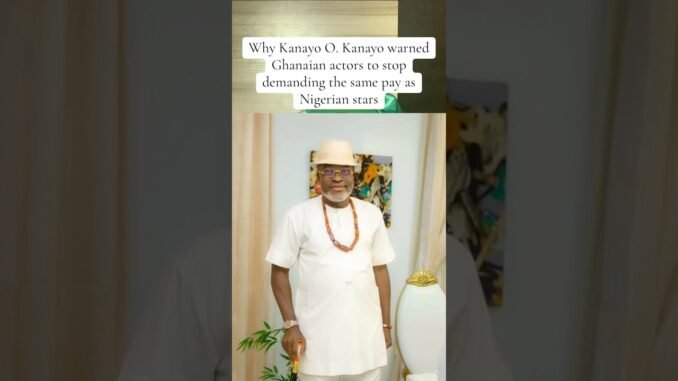

Summary: Nollywood veteran Kanayo O. Kanayo has zero patience for Ghanaian actors demanding equal pay with their Nigerian counterparts. Here’s what the legendary actor had to say — and why his words are making waves across West Africa.
If there’s one thing Nigerians know about Kanayo O. Kanayo, it’s that the man does not mince words. The veteran Nollywood icon — famous for his iconic roles and those ritual movie scenes that had us hiding behind our pillows as children — has once again stepped into the spotlight, but this time, it’s not for any movie role. It’s to deliver a sharp, no-nonsense message to Ghanaian actors who have been demanding the same appearance fees as their Nigerian colleagues before agreeing to feature in productions.
And as expected, e no go down smooth.
—
“That Na Their Business” — KOK Goes In
Kanayo O. Kanayo made it crystal clear that what Nigerian actors earn is simply not the concern of their Ghanaian counterparts. According to the legendary actor, Ghanaian performers have no business setting their asking price based on what Nollywood stars command in the industry.
For those who may not know the full gist, some Ghanaian actors have reportedly been pushing back against productions — insisting on being paid fees comparable to what top Nigerian talent receives before they agree to come on board. To Kanayo, that approach is not just unreasonable — it’s simply out of place.
—
Why This Matter Is Bigger Than Just Money
Let’s be real — this conversation touches on something deeper than naira and pesewas. It’s about industry positioning, market value, and the undeniable dominance of Nollywood on the African entertainment stage.
Nollywood is not just Nigeria’s pride — it is the second largest film industry in the world by volume, producing thousands of movies every year and generating billions in revenue. Nigerian actors like Genevieve Nnaji, Ramsey Nouah, and of course Kanayo O. Kanayo himself, have built their brands over decades of hard work, visibility, and audience loyalty that stretches from Lagos to London.
That kind of market pull does not happen by accident — and it certainly doesn’t transfer automatically just because someone crosses the border.
—
The Nollywood Value Proposition
When a Nigerian A-list actor signs on to a project, they bring with them:
– Millions of loyal fans across Nigeria and the diaspora
– Massive social media followership that drives organic buzz
– Box office credibility that can make or break a film’s commercial performance
– Decades of brand equity built through consistent work and public presence
The fees they command reflect all of this. It’s not just payment for showing up — it’s payment for the entire ecosystem of value they bring with them.
So when Kanayo says Ghanaian actors need to stay in their lane on this one, he’s really saying: build your own market value, and your fees will follow.
—
A Word for the Culture
This is not a shade-throwing exercise — West African unity remains important, and the creative industries of Nigeria and Ghana have historically had a beautiful, collaborative relationship. Ghanaian artists have contributed meaningfully to African entertainment, and that deserves its own recognition.
But respect in the entertainment industry is earned through audience numbers, box office returns, and cultural reach. If Ghanaian actors want to command Nollywood-level fees, the answer is not to demand them — the answer is to build the kind of following and industry presence that justifies those numbers.
As we say in Nigeria: you cannot eat where you did not farm.
—
Bottom Line
Kanayo O. Kanayo has spoken, and whether you agree with him or not, the man has a point. The entertainment industry is a marketplace, and market rates are determined by demand, influence, and proven value — not by geographic proximity or comparison alone.
Nigerian actors have paid their dues. Their fees reflect that. And as KOK rightly put it — what they get paid is simply not your business.
What do you think? Is Kanayo right to draw this line, or should West African creatives push for more unified standards across the industry? Drop your thoughts in the comments below! 👇
For more details, check buzzUp9ja
Be the first to comment