

Summary: As Cuba battles nationwide power collapse, U.S. President Trump threatens takeover while Russia pledges support. What this means for the communist island nation facing its worst crisis in decades.
The Caribbean island nation of Cuba is facing one of its darkest hours—literally and figuratively—as the country plunged into total darkness for the third time in four months, while U.S. President Donald Trump openly declares his intention to “take” the communist-run country.
On March 16, Cuba’s Ministry of Energy and Mines announced that the National Electric System (SEN) suffered a complete shutdown, leaving all 10 million Cubans without power. The ministry did not provide details about what caused the collapse or when electricity would be restored to the crisis-hit nation.
“I Think Cuba is Seeing the End” – Trump
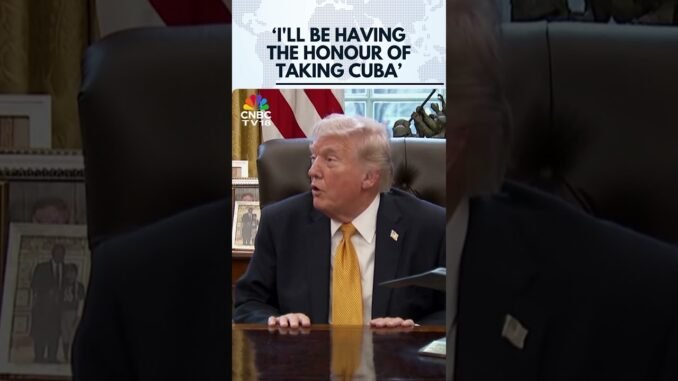
Speaking from the Oval Office on the same day as the blackout, President Trump made his intentions crystal clear. “I think Cuba is seeing the end,” he told reporters, adding that he expects to have the “honour” of “taking” the country. “They’re a very weakened nation right now.”
Trump’s bold statement comes as his administration has already forced major regime changes this year. In January, U.S. forces captured Venezuelan President Nicolás Maduro in what was described as a daring military operation. Last month, Iran’s Supreme Leader Ayatollah Ali Khamenei was killed during joint U.S.-Israeli military operations.
According to reports, the Trump administration is now working to remove Cuba’s current leader, President Miguel Díaz-Canel, though no official confirmation has been made.
Cuba’s Perfect Storm of Crises
The timing couldn’t be worse for Havana. For decades, Cuba has struggled with severe economic challenges, including acute shortages of food, fuel, and electricity. The recent capture of Venezuela’s Maduro—a key Cuban ally and benefactor—has only worsened the situation.
Long-standing U.S. sanctions, aimed at toppling Cuba’s communist regime, have strangled the island’s economy. Recent energy embargoes have pushed Cuba’s already fragile power grid to the breaking point, making nationwide blackouts increasingly common.
Russia Steps In: “Unwavering Solidarity”
On March 17, Russia issued a strong statement condemning what it called interference in the affairs of a sovereign state. Without mentioning Trump by name, Russia’s foreign ministry warned against intimidation and unilateral sanctions.
Moscow declared its “unwavering solidarity” with Cuba’s government and people, promising to maintain contact with Cuban leadership and provide support, including financial assistance.
Russian officials described the difficulties facing Cuba as “unprecedented,” directly blaming long-standing U.S. sanctions and the recent energy embargo for the country’s crumbling infrastructure.
A History of Cold War Alliances
Cuba’s close relationship with Russia dates back to 1959, when revolutionary leader Fidel Castro overthrew a U.S.-backed government and aligned the island with the then-Soviet Union, establishing Cuba as a socialist state just 90 miles from American shores.
Fidel Castro ruled Cuba until his death in 2016, having handed over the presidency to his brother Raúl in 2008. When Raúl Castro stepped down as president in 2018, Miguel Díaz-Canel took over, though the Castro family remains influential in Cuban politics. Raúl served as Communist Party First Secretary until 2021.
Throughout the decades, Moscow has continued to support Cuba through financing and material aid, making Russia’s latest pledge of assistance a continuation of a long-standing alliance.
What This Means for Nigeria and Africa
For Nigerian readers, the situation in Cuba offers important lessons about international relations and the dangers of over-dependence on single allies. Just as Cuba suffered when its key benefactor Venezuela collapsed, African nations must diversify their economic partnerships.
The confrontation between Russia and the United States over Cuba also highlights how smaller nations can become pawns in great power rivalries—a situation not unfamiliar to many African countries during the Cold War era.
As tensions rise between global powers, the Cuban crisis serves as a reminder that sovereignty and self-determination remain fragile in the face of economic sanctions and military threats.
Looking Ahead
With Trump’s attention now focused on Cuba, the island nation faces an uncertain future. Will Russia’s support be enough to sustain the communist regime? Can Cuba’s government survive the mounting pressure from Washington?
For now, Cubans struggle in darkness—both literal and metaphorical—as their country becomes the latest battleground in a new era of great power competition.
The coming weeks will reveal whether Trump’s threats materialize into action, and whether Russia’s promises of support translate into meaningful assistance for a nation facing its greatest crisis since the revolution.
For more details, visit buzzUp9ja
Be the first to comment