
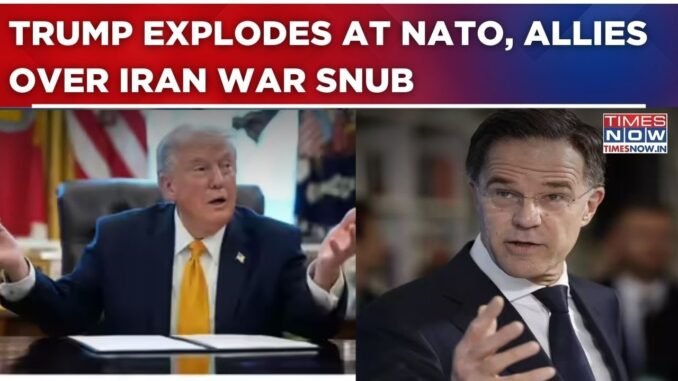

Summary: U.S. President Donald Trump has lashed out at NATO allies after they refused to support American military operations in the strategic Strait of Hormuz, sparking fresh concerns about the strength of Western alliances.
In a fiery outburst that has sent shockwaves through diplomatic circles, United States President Donald Trump has openly criticized NATO and several key allies for refusing to back American efforts in the escalating Iran crisis.
Speaking from the White House during a meeting with Irish Prime Minister Micheál Martin on Tuesday, Trump didn’t mince words as he expressed his disappointment with the military alliance’s response to the Strait of Hormuz situation.
“NATO Has Failed a Key Test of Loyalty”
“I think NATO is making a very foolish mistake,” Trump declared. “I’ve long said that I wonder whether or not NATO would ever be there for us. So this was a great test.”
The American president’s frustration stems from several U.S. allies declining to participate in a proposed military mission to escort commercial ships through the Strait of Hormuz—one of the world’s most important oil shipping routes that many Nigerians know affects global fuel prices.
French President Emmanuel Macron was particularly firm in his rejection, stating that France would “never” participate under current conditions. The French leader insisted that the situation must first stabilize before any European involvement could be considered.
“We Don’t Need Any Help” – Trump’s Defiant Stance
Despite facing a wall of resistance from traditional allies, Trump maintained that America is more than capable of handling the Iran situation alone.
“We don’t need too much help. We don’t need any help,” he said confidently, later adding on social media that the U.S. military has achieved enough success to operate without NATO’s support.
The president expanded his criticism beyond European allies, claiming that countries including Japan, Australia, and South Korea were also unwilling to get involved—describing the entire NATO arrangement as a “one-way street” where America gives more than it receives.
Personal Attacks on Allied Leaders
Trump didn’t stop at criticizing countries; he took direct aim at individual leaders. He called out British Prime Minister Keir Starmer for not being supportive, labelling it a “big mistake.” He also dismissed Macron’s position, suggesting the French leader would soon be out of office anyway.
These sharp words have raised serious questions about the future of Western military cooperation, with Trump hinting that the U.S. relationship with NATO could be reconsidered—though he mentioned no immediate plans for such drastic action.
Why the Strait of Hormuz Matters
For Nigerians watching fuel prices climb at filling stations across Lagos, Abuja, and Port Harcourt, the Strait of Hormuz crisis is more than distant news. This narrow waterway handles a significant portion of the world’s crude oil supply, and any disruption directly impacts global energy markets.
Iran has recently targeted regional energy infrastructure and threatened oil tankers passing through the strait, creating serious security concerns for international shipping. The resulting disruption has already contributed to rising global oil prices—a development that inevitably affects Nigeria’s economy and the cost of living for ordinary citizens.
Mixed Signals on the Conflict
Adding to the confusion, Trump offered contradictory messages about the scope and duration of American involvement. He described the situation in Iran as “just a military operation” and suggested U.S. involvement could end soon, yet remained vague about long-term plans for Iran’s leadership.
The conflict has intensified across the Middle East, and the pressure is mounting on U.S. allies to clarify their positions as the situation becomes increasingly complex.
What This Means for Global Security
Trump’s public criticism of NATO represents a significant moment in post-World War II Western alliance politics. The North Atlantic Treaty Organization was founded on the principle of collective defence—the idea that an attack on one member is an attack on all.
However, the current standoff reveals deep divisions over when and how that principle should apply, especially when it comes to American-led operations outside the traditional NATO area of responsibility.
As tensions continue to simmer in the Persian Gulf, the world watches to see whether the United States will indeed go it alone, or whether diplomatic efforts can bridge the growing divide between Washington and its traditional allies.
For Nigeria and other oil-dependent economies, the hope remains that a peaceful resolution can be found before the crisis pushes global energy prices even higher.
Stay updated on buzzUp9ja for more details
Be the first to comment