
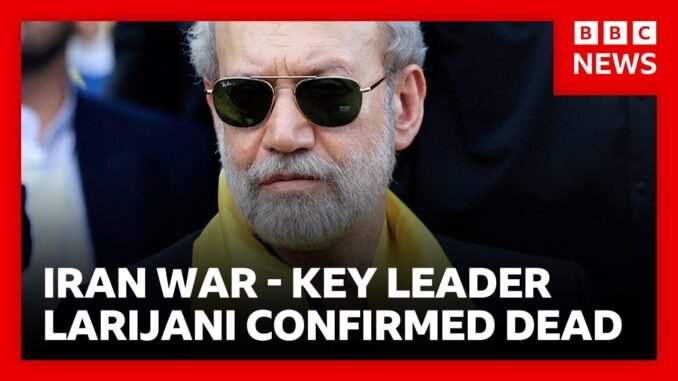

Summary: Iran confirms the death of influential political figure Ali Larijani in an Israeli airstrike near Tehran. Explore his legacy, role in Iran’s nuclear programme, and what his death means for regional stability.
Iran has officially confirmed the death of Ali Larijani, one of the Islamic Republic’s most powerful and influential political figures, following a targeted Israeli airstrike. The 67-year-old political veteran, often described as a “de-facto leader” and master strategist behind Iran’s security policies, was killed during a U.S.-Israeli joint operation while visiting his daughter on the outskirts of Tehran.
The announcement was made by Iran’s semi-official Fars news agency, while Israel’s Defence Minister, Israel Katz, separately confirmed that Larijani had been eliminated in a precision strike. His death represents a major blow to Iran’s political establishment, coming at a particularly volatile time for the Middle Eastern power.
A Power Broker at the Heart of Iranian Politics
Ali Larijani was no ordinary politician. For decades, he stood as a central figure in Iran’s complex power structure—a man who understood both the language of diplomacy and the realities of hardline politics. His influence stretched across multiple administrations, making him one of the most enduring personalities since the 1979 Iranian Revolution.
A veteran of the brutal Iran-Iraq War of the 1980s, Larijani climbed through the ranks of the Islamic Republic with a combination of strategic thinking and political savvy. His resume reads like a who’s who of Iranian power: head of the Supreme National Security Council, Speaker of Parliament for 12 years, and Iran’s chief nuclear negotiator during some of the most tense moments in the country’s modern history.
Architect of Iran’s Nuclear Strategy
Perhaps Larijani’s most significant legacy lies in his role shaping Iran’s controversial nuclear programme. Known for his pragmatic yet firm approach, he was instrumental in maintaining Iran’s relationships with global powers like Russia and China, even as Western nations imposed crippling sanctions.
He played a key role in the negotiations that led to the landmark 2015 nuclear deal—an agreement that promised sanctions relief in exchange for limits on Iran’s nuclear activities. The deal, formally known as the Joint Comprehensive Plan of Action (JCPOA), was seen as a rare diplomatic victory. However, it later collapsed when former U.S. President Donald Trump withdrew America from the agreement, plunging Iran back into economic hardship.
A Moderate Among Hardliners—With a Dark Side
While many international observers viewed Larijani as a moderate voice within Iran’s hardline establishment, his record was far from clean. He was closely linked to the violent crackdown on mass protests that erupted across Iran earlier this year, actions that drew condemnation from human rights groups worldwide and resulted in sanctions from Washington.
This dual nature—diplomat and enforcer—made Larijani both respected and feared. He was a close adviser to former Supreme Leader Ali Khamenei, who was himself killed in an airstrike just last month, leaving Iran’s leadership in turmoil.
A Nation in Crisis
Larijani’s death comes at a critical juncture for Iran. With Khamenei gone and internal power struggles intensifying, the country’s political landscape is increasingly dominated by the Revolutionary Guards—a powerful military and economic force that often favours confrontation over compromise.
Analysts suggest that figures like Larijani, who could balance diplomatic engagement with ideological loyalty, are becoming rare. His passing removes yet another pillar from Iran’s already shaky political foundation, raising questions about who will fill the vacuum and what direction the country will take next.
What This Means for the Region
The targeted killing of such a high-profile Iranian official is likely to escalate tensions across the Middle East. Iran has historically responded to such attacks with retaliatory strikes, either directly or through its network of allied militias across Lebanon, Syria, Iraq, and Yemen.
For Nigeria and other African nations watching these developments, the implications could be felt in global oil markets, where Iran remains a significant—if currently constrained—player. Any further escalation could drive up energy prices, affecting economies worldwide.
As the dust settles on this latest strike, one thing is clear: the Middle East remains a powder keg, and the death of Ali Larijani has just added more fuel to the fire.
Check buzzUp9ja for more details
Be the first to comment