
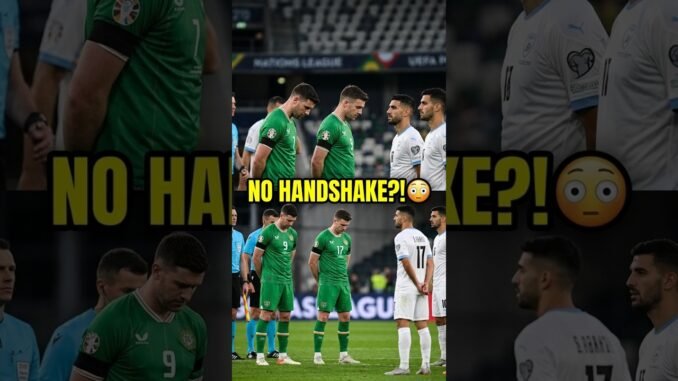

Irish national team players make a powerful political statement during UEFA Nations League fixture, refusing to shake hands with Israeli opponents or stand for their anthem
The Republic of Ireland football players made headlines across the world on Sunday when they flatly refused to shake hands with their Israeli counterparts before their UEFA Nations League clash held at the Nagyerdei Stadion in Hungary. As if that was not enough, the Irish players also turned their backs on the Israeli national anthem — a move that sent shockwaves through the football world and sparked heated debate from Dublin to Tel Aviv.
What Exactly Happened?
Before the match kicked off, when it was time for the customary pre-match handshakes — that polite tradition where both teams line up and greet each other — the Irish players simply refused to participate. They stood their ground, arms folded or by their sides, as their Israeli counterparts walked past.
Then came the national anthems. As Israel’s anthem played out across the stadium, the Republic of Ireland players visibly snubbed the moment, refusing to show the customary respect typically extended to an opposing nation’s anthem during international fixtures.
For context, this is a very big deal in international football. Pre-match handshakes and standing respectfully for anthems are deeply embedded traditions in the beautiful game. Walking away from them is not something any team does lightly — it is a deliberate, calculated statement.
Why Did They Do It?
The backdrop to this protest is impossible to ignore. The ongoing conflict in Gaza has claimed tens of thousands of lives, with images of destruction and human suffering dominating global news coverage for months. Ireland has been one of the most vocal European nations in criticising Israel’s military campaign, with the Irish government formally recognising the State of Palestine earlier in 2024.
For the Irish players, this was clearly not just football — it was a moment to stand on the right side of history, in their own estimation. The gesture aligned with a broader Irish tradition of solidarity with peoples who have experienced occupation and struggle, rooted partly in Ireland’s own complex colonial history.
The Reaction: Mixed Feelings All Around
As you can imagine, reactions were sharp and divided:
– Supporters of the gesture praised the Irish players for using their platform to make a moral statement, arguing that silence in the face of injustice is itself a statement.
– Critics argued that football should remain separate from politics, and that such gestures create unnecessary tension in what should be a sporting contest.
– UEFA was put in a potentially awkward position, given that football’s governing bodies have generally tried — not always successfully — to keep politics off the pitch.
What Nigerians Should Take From This
Here in Nigeria, we understand better than most what it means when sport intersects with politics and human rights. From the historic boycotts of apartheid-era South Africa to athletes using global stages to speak truth to power, sport has never truly been “just sport.”
Whether you agree with the Irish players’ approach or not, one thing is clear — they were willing to face potential backlash, disciplinary action, and international controversy to stand for something they believe in. That kind of conviction, regardless of your position on the matter, deserves serious thought.
The question this raises for all of us is simple: When you have a platform, however big or small, what will you use it for?
What do you think about the Irish team’s decision? Was it a brave stand or an unnecessary politicisation of football? Drop your thoughts in the comments section below.
Get fresh news daily on buzzUp9ja
Be the first to comment