
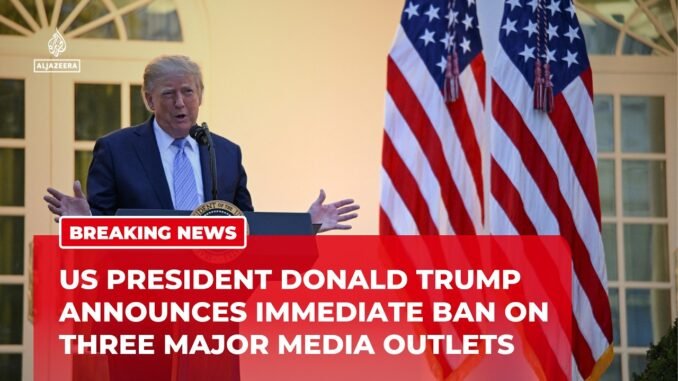

The battle between the Trump administration and major media outlets is heating up — and this time, the courts are involved.
—
The United States Department of Justice has thrown its full weight behind President Donald Trump’s decision to ban CNN, MSNBC, and Politico from accessing the White House, arguing that entry into restricted presidential spaces is a privilege, not a right — and that the banned outlets pose a threat to national security.
This development marks yet another dramatic chapter in the ongoing war between the Trump administration and what the president famously calls the “fake news” media.
—
What Is Actually Happening?
The Justice Department is essentially telling the courts: “The President of the United States does not owe any journalist a seat at the table.” According to the DOJ, access to restricted areas within the White House — including press briefings and other official functions — is not a constitutional guarantee but rather a privilege that can be withdrawn at any time.
The administration went further, claiming that the news organisations that were barred had, in some way, threatened national security — a serious allegation that has raised eyebrows across the global media community.
—
This Is Not Just an American Problem
For Nigerians watching from the sidelines, this situation should feel familiar. The tension between government and the press is a story we know all too well on this side of the Atlantic.
From the days of military juntas silencing journalists, to more recent attempts to regulate social media and online news platforms, the struggle to define what press freedom actually means is one that plays out in democracies and autocracies alike.
The difference here is that this is happening in the United States — long held up as the gold standard of press freedom globally. When America sneezes, as they say, the rest of the world catches a cold.
—
The Key Argument: Privilege vs. Right
The core of the Justice Department’s position rests on a legal distinction that may sound technical but carries enormous consequences:
– If press access is a RIGHT, then the government cannot arbitrarily remove it without due process.
– If press access is a PRIVILEGE, then it can be granted or withdrawn based on the administration’s discretion.
The Trump administration is firmly in the “privilege” camp, and the DOJ is now making that case in court.
Critics, however, argue that allowing any sitting president to personally decide which journalists get access — and which do not — is a dangerous precedent that essentially gives the executive branch the power to shape its own media coverage.
—
The “National Security” Card
Calling news organisations a national security threat is not a small thing. This is the kind of language typically reserved for foreign spies, terrorist organisations, or hostile state actors — not journalists doing their jobs.
Many press freedom advocates have described the claim as an overreach, warning that it sets a troubling template that authoritarian governments around the world could easily copy and apply to silence their own local media.
Sound familiar, Nigeria?
—
What Happens Next?
The matter is now before the courts, and the outcome could fundamentally reshape the relationship between the American government and the press for years to come.
If the courts side with the Trump administration, it would effectively give sitting presidents enormous power to curate their own media environment — shutting out critical voices and rewarding friendly ones.
If the courts rule against the DOJ, it would reaffirm that a free press is not just a nicety in a democracy, but a non-negotiable pillar that no president — no matter how powerful — can simply wave away.
—
The Bottom Line
Whether you are in Lagos, Abuja, Kano, or Port Harcourt, the lesson from this unfolding drama in Washington is clear: the freedom of the press is never truly settled. It must be defended, challenged, and protected in every generation.
As Nigerians who understand what it means to operate in environments where media freedom is contested, we should be watching this case very closely. Because the arguments being made in American courtrooms today could very well inspire policy decisions in our own backyard tomorrow.
Stay informed. Stay engaged. Because when the press loses, we all lose.
For more information, check buzzUp9ja
Be the first to comment