
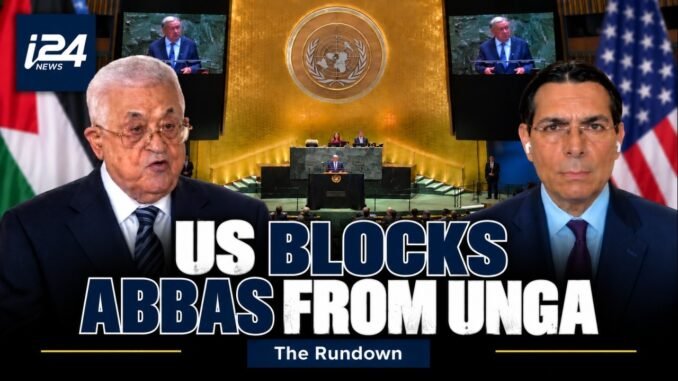

Summary: The United States has blocked Palestinian President Mahmoud Abbas from attending the UN General Assembly in New York, raising fresh concerns about America’s role in the Israeli-Palestinian conflict.
In a move that has sparked serious diplomatic tensions, the United States has refused to grant Palestinian President Mahmoud Abbas an entry visa to attend the United Nations General Assembly (UNGA) in New York next week.
This development comes as the US government announced it was extending visa sanctions — a decision that has drawn sharp reactions from world leaders, human rights advocates, and diplomatic circles across the globe.
What Happened?
For those who may not be familiar, the UN General Assembly is one of the biggest diplomatic gatherings in the world — think of it as the Aso Rock of global politics, where heads of state and world leaders meet annually to address pressing international issues. Being denied access to such a stage is not a small matter at all.
Abbas, who leads the Palestinian Authority, was expected to address world leaders at the assembly — a platform he and his predecessors have used for decades to press the case for Palestinian statehood and rights.
But Washington slammed the door shut.
Why This Matters
This decision raises serious questions, especially given that the UN headquarters is physically located on American soil in New York City. Critics argue that the US, as the host nation, has an obligation under international law to grant visas to world leaders attending UN functions — regardless of political differences.
Many observers are asking: Is America using its visa powers to silence a voice it finds inconvenient?
The timing is particularly sensitive. With the ongoing conflict between Israel and Hamas still very much a raw wound internationally, denying Abbas — the leader of the Palestinian Authority and a key figure in any future peace negotiations — access to the world stage sends a loud and troubling message.
The Bigger Picture
For Nigerians and Africans who understand what it means to be denied a voice — whether in colonial history or in present-day global institutions — this story hits differently. Many African nations have long advocated for Palestinian rights at the UN, with Nigeria historically supporting a two-state solution.
This visa denial essentially muzzles a sitting head of state from addressing the very international body designed to resolve conflicts like the one his people are living through every single day.
It is worth remembering that powerful nations often use administrative tools — like visa denials — to shape global narratives. And when those tools are used against the already vulnerable, the world must pay attention.
What Happens Next?
Palestinian officials have condemned the move, and it is expected to add more friction to already strained US-Palestinian relations. Other world leaders attending UNGA may raise the issue on the floor of the assembly — turning America’s visa decision into a diplomatic talking point in the very meeting Abbas was denied entry to attend.
As the world watches, one thing is clear: the Palestinian question remains one of the most consequential — and contested — issues of our time.
What do you think about this development? Should the US be allowed to deny world leaders access to the UN General Assembly? Drop your thoughts in the comments below.
Uncover more details on buzzUp9ja
Be the first to comment