
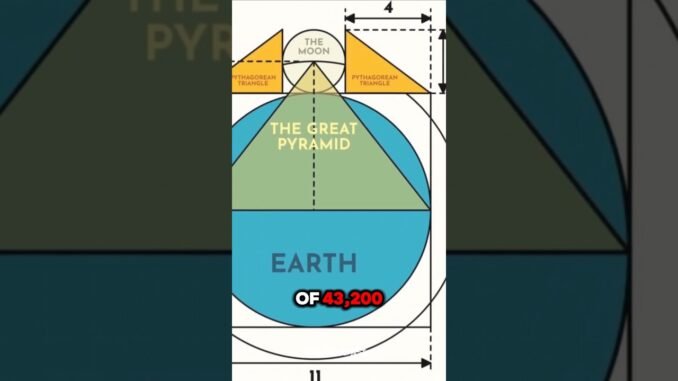

If you think maths is just something that tortures students in WAEC exams, think again. Researchers are now saying that one of the world’s most iconic ancient structures — the Great Pyramid of Giza — may have been intentionally built as a giant mathematical textbook, quietly preserving knowledge for thousands of years.
And the deeper you look into the numbers, the harder it becomes to dismiss this as mere coincidence.
So, What Did They Find?
Independent researcher Sefy [and team] have put forward a fascinating new theory: the Great Pyramid of Giza was not just built as a tomb or a show of royal power — it was carefully designed to encode mathematical and astronomical knowledge directly into its physical dimensions and proportions.
In plain English? The ancient Egyptians may have deliberately embedded secret codes into the very measurements of the pyramid — almost like hiding a USB drive inside a wall, except the “drive” is made of millions of limestone blocks and has been standing for over 4,500 years.
The Numbers That Are Raising Eyebrows
Here is where it gets genuinely interesting. When researchers carefully analysed the pyramid’s dimensions and proportions, they found what appears to be deliberate mathematical relationships embedded within the structure. These are not rough estimates or vague approximations — the precision is striking enough to suggest intentional design rather than happy accident.
Think about it this way: if you were to randomly stack millions of stones, the chances of accidentally encoding specific mathematical ratios and astronomical data into the final structure would be astronomically small. Yet, here we are.
Why Should Nigerians Care?
Now, some people might ask — “Why should this matter to me in Lagos, Abuja, or Kano?”
Here is why: this discovery is not just about Egypt. It is about African ingenuity.
The Great Pyramid was built by Africans. Full stop. And the idea that these builders were sophisticated enough to embed complex mathematical and astronomical knowledge into their architecture thousands of years before modern science — that is a deeply powerful statement about the intellectual heritage of the African continent.
At a time when African history is often minimised or overlooked in global conversations, findings like this serve as a powerful reminder: Africa was doing advanced science when much of the world was still figuring things out.
This is the kind of history that deserves to be taught with pride in our schools, discussed in our universities, and celebrated in our culture.
What Kind of Knowledge Was Being Preserved?
According to the theory, the pyramid’s proportions may reflect knowledge of:
– Mathematical constants — precise ratios that appear embedded in the structure’s geometry
– Astronomical data — information about celestial bodies and movements encoded into the physical design
– Geometric principles — relationships between shapes, angles, and measurements that demonstrate deep mathematical understanding
The suggestion is that the ancient Egyptians may have used the pyramid as a kind of permanent knowledge vault — a way of ensuring that critical scientific understanding would survive long after any papyrus scrolls or human memory had faded away.
Honestly, that level of forward-thinking is something even our 21st-century institutions could learn from.
“But Is It Not Just a Coincidence?”
This is the question sceptics always ask — and it is a fair one.
The honest answer is that the debate is still ongoing in academic and research circles. Not every mainstream archaeologist is ready to fully embrace the theory just yet, and that is how good science works. Claims must be tested, challenged, and verified.
However, what makes this theory compelling is the sheer consistency of the mathematical relationships found. When multiple independent measurements keep pointing to the same deliberate patterns, at some point coincidence becomes a very difficult argument to sustain.
It is the same reason why, if someone scores 100% in every single subject in an exam, you start to suspect they did not just guess randomly.
The Bigger Picture
What this research ultimately points to is something historians and Afrocentric scholars have been arguing for decades: ancient African civilisations were far more scientifically and mathematically advanced than popular culture gives them credit for.
The Great Pyramid has stood for millennia — surviving wars, empires, climate shifts, and countless human generations. If it truly was designed to preserve knowledge, then it has done its job spectacularly well.
And the fact that we are still unlocking its secrets today? That might have been the plan all along.
As Nigerians, we come from a continent with one of the richest intellectual and cultural histories on earth. Stories like this are not just fascinating — they are part of our heritage. Share this with someone who needs a reminder of just how brilliant Africa has always been.
Get all the details on buzzUp9ja
Be the first to comment