

Summary: Israel alleges the brother of Michigan synagogue attacker Ayman Ghazali was a Hezbollah commander killed in Lebanon airstrike, as Middle East tensions spark concerns over revenge attacks in America.
The Israeli military has made startling claims that the brother of the man who attacked a Michigan synagogue last week was a high-ranking Hezbollah commander killed in an Israeli airstrike just days before the American assault.
According to a statement released by the Israel Defense Forces (IDF) on social media platform X, Ibrahim Mohamad Ghazali held a command position within Hezbollah’s specialized Badr unit, where he allegedly oversaw weapons operations. The IDF stated that his unit was responsible for launching “hundreds of rockets toward Israeli civilians.”
The military added that Ibrahim Ghazali “was eliminated in an [Israeli air force] strike on a Hezbollah military structure last week” in Lebanon.
The Michigan Synagogue Attack
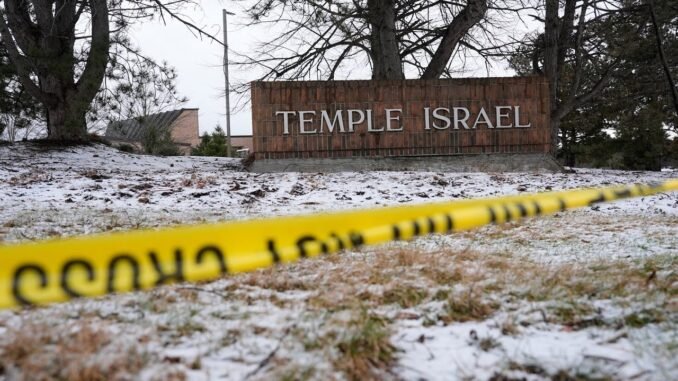
His brother, Ayman Mohamad Ghazali, carried out a shocking attack on Temple Israel in West Bloomfield Township, Michigan on Thursday. The 40-year-old Lebanese-born naturalized US citizen drove his Ford F-150 truck directly into the synagogue before opening fire.
The attack targeted one of the largest Jewish worship centers in the United States, housing 103 children and nearly 50 staff members, teachers, and clergy at the time. Fortunately, enhanced security measures prevented what could have been a massive tragedy.
An armed private security guard confronted Ghazali and exchanged gunfire with him. During the confrontation, the truck’s engine caught fire, setting off gasoline and fireworks stored in the vehicle. Ghazali ultimately took his own life after being confronted by security. The guard sustained injuries, but remarkably, no one inside the synagogue was harmed.
A Family Tragedy Turned Violent
A Hezbollah official speaking to the New York Times claimed that Ayman Ghazali’s attack was motivated by revenge for the deaths of four family members killed in an Israeli airstrike on March 5 in Lebanon.
According to Imam Hassan Qazwini of the Islamic Institute of America, Ayman attended a memorial service for his slain relatives—including two children and another brother besides Ibrahim—at a mosque in Dearborn Heights, Michigan, just three days before the synagogue attack on March 8.
The Hezbollah official did not confirm or deny the IDF’s claims about Ibrahim Ghazali’s role in the militant organization.
The Lebanese Airstrike
The IDF stated that its March 5 strike targeted a “military structure” in Mashgharah, Lebanon, where weapons were allegedly stored and Hezbollah operatives were present. Lebanese officials reported that the airstrike hit a three-story building. Ibrahim Ghazali’s wife was seriously wounded in the attack.
Growing Concerns About Spillover Violence
The Michigan attack has raised serious concerns among American security officials about potential revenge actions on US soil linked to escalating Middle East conflicts.
Michigan Senator Elissa Slotkin credited the synagogue’s security measures for preventing mass casualties, stating: “If they had not done their job almost perfectly we would be talking about an immense tragedy here today with children gone.”
Governor Gretchen Whitmer also praised the security personnel, calling them “heroes” who “threw themselves in harm’s way, engaging a suspect.”
US House member Adam Smith of Washington state warned on ABC’s This Week that the Middle East conflict has “exacerbated” the risk of politically motivated lone wolf attacks in America.
“We’d be wrong to say it sparked it… but we need to be prepared for those,” said Smith, the top Democrat on the House Armed Services Committee. He added that the conflict “is without question spreading right now.”
Regional Tensions Escalate
Tensions between Israel and Hezbollah have intensified dramatically since late February, when the US and Israel launched military operations in Iran following a missile strike that killed Iranian supreme leader Ayatollah Ali Khamenei.
Hezbollah retaliated by firing rockets into Israel on March 2, prompting Israeli airstrikes that Lebanon’s health ministry estimates have killed roughly 800 people.
Temple Israel had previously strengthened its security measures following past attacks on places of worship and rising antisemitic incidents across America—precautions that ultimately saved lives during this attack.
As Middle East tensions continue to simmer, security experts warn that American communities may increasingly face spillover violence from conflicts thousands of miles away, making vigilance and preparedness more critical than ever.
For more details, check buzzUp9ja
Be the first to comment