
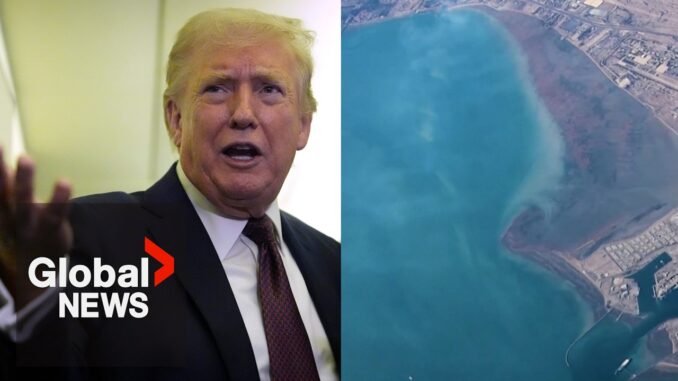

Summary: As tensions escalate in the Middle East, Iran warns foreign nations against military involvement while Trump calls on global allies to escort oil tankers through the Strait of Hormuz. Oil prices surge 40% amid growing conflict.
The crisis in the Middle East has reached a dangerous new phase as Iran issued stern warnings to countries considering military involvement in the escalating conflict with the United States and Israel. The warning comes after former U.S. President Donald Trump called on several nations to deploy naval forces to protect oil tankers passing through the Strait of Hormuz—a critical waterway that Nigeria and the rest of the world depend on for energy supplies.
The Global Oil Supply Under Threat
For Nigerians already grappling with fuel scarcity and rising petrol prices, this international crisis carries significant implications. The Strait of Hormuz, a narrow waterway connecting the Persian Gulf to the open ocean, handles roughly one-fifth of the world’s oil shipments. Any disruption to this vital passage directly affects global oil prices—and ultimately, the cost of petrol, diesel, and kerosene in Nigerian filling stations.
Since Iran began threatening ships passing through the strait, global energy prices have jumped by approximately 40 percent. This surge threatens to further strain Nigeria’s economy, which is still recovering from previous fuel subsidy removals and naira devaluation.
Trump’s Call for International Naval Escort
On Saturday, Trump urged major global powers including “China, France, Japan, South Korea, the UK and others” to send military ships to escort oil tankers through the strategic passage. This request came as U.S. military forces continue launching strikes on Iranian drone, missile, and naval facilities along the northern Gulf coast.
However, the countries mentioned have responded with caution rather than commitment. The United Kingdom’s Ministry of Defence acknowledged ongoing discussions but stopped short of pledging forces. Britain’s energy security minister, Ed Miliband, emphasized the need for diplomacy, telling the BBC: “The plan now has to be to de-escalate the conflict.”
Asian nations also expressed reservations. South Korea said it was “closely monitoring” Trump’s social media statements, while Japan indicated that the legal requirements for deploying naval forces were “extremely high.”
Iran Issues Strong Warning Against Foreign Intervention
Iran’s foreign minister, Abbas Araghchi, made the country’s position clear during a phone conversation with French foreign minister Jean-Noel Barrot. He urged France and other nations to “refrain from any action that could lead to escalation and expansion of the conflict.”
The warning reflects Iran’s determination to prevent the conflict from drawing in additional military powers, which could transform a regional crisis into a global confrontation with devastating consequences for international trade and energy supplies.
What Sparked This Crisis?
The current escalation is part of a wider Middle East conflict that began after a joint U.S.-Israeli air campaign resulted in the death of Iran’s supreme leader. Iran’s response included restricting traffic through the Strait of Hormuz and launching attacks on energy facilities in neighbouring Gulf states.
According to the United States Department of Defense, more than 15,000 targets in Iran have been struck by U.S. and Israeli forces since the conflict began. The Iranian health ministry reports that over 1,200 people have been killed, while the United Nations High Commissioner for Refugees estimates that up to 3.2 million people have been displaced within Iran.
Trump’s Controversial Remarks and Future Plans
In a recent interview with NBC News, Trump made controversial statements about potential military actions against Iran’s key oil export hub, Kharg Island, suggesting the U.S. might bomb the facility “just for fun.” He also indicated that while negotiations with Tehran were possible, they were “not imminent” because “the terms aren’t good enough yet.”
Iran’s new supreme leader, Mojtaba Khamenei, has vowed to keep the Strait of Hormuz closed, though he has not appeared publicly since assuming power. Trump even questioned whether Khamenei was still alive, saying: “I don’t know if he’s even alive. So far, nobody has been able to show him.”
Iranian officials insisted on Saturday, March 14, that “there is no problem with the new supreme leader.”
Life in Tehran and Regional Attacks
Despite the ongoing conflict, life in Tehran is slowly returning to normal. Traffic has increased across the city, cafés and restaurants have reopened, and more than a third of the stalls at the popular Tajrish Bazaar have resumed business as residents prepare for Nowruz, the Persian New Year celebration.
However, elsewhere in the region, tensions remain high. Bahrain and Saudi Arabia reported intercepting projectiles after warning sirens sounded in Manama, the Bahraini capital. Dubai authorities also reported air defence interceptions following Iranian warnings for civilians to avoid port areas.
The Israel Defense Forces launched a new wave of strikes in western Iran after the Islamic Revolutionary Guard Corps threatened Israeli Prime Minister Benjamin Netanyahu and vowed to “pursue and kill” him.
What This Means for Nigeria
For Nigeria, a major oil-producing nation that also depends on petroleum imports for domestic consumption, this crisis presents both challenges and opportunities. While disruptions to global oil supply could drive up crude prices—potentially benefiting government revenue—the same increase makes refined petroleum products more expensive to import.
With Nigeria’s refineries still operating below capacity despite the recent reopening of the Dangote Refinery, any sustained spike in global oil prices could worsen fuel availability and affordability for ordinary Nigerians.
The U.S. has reportedly deployed the amphibious assault ship USS Tripoli along with thousands of Marines to the region as the conflict intensifies, signalling that the situation may worsen before it improves.
The Path Forward
As international leaders navigate this crisis, the emphasis from most responsible governments appears to be on de-escalation and diplomacy rather than military confrontation. The stakes are simply too high—not just for the Middle East, but for the entire global economy.
For Nigerians monitoring this situation, the key concern remains how quickly diplomatic solutions can be found to reopen the Strait of Hormuz and stabilize global energy markets. Until then, we may continue to feel the effects at our filling stations and in our daily transportation costs.
The coming weeks will be critical in determining whether cooler heads prevail or whether this regional conflict escalates into a broader international crisis with far-reaching consequences for Nigeria and the world.
Visit buzzUp9ja for more details
Be the first to comment