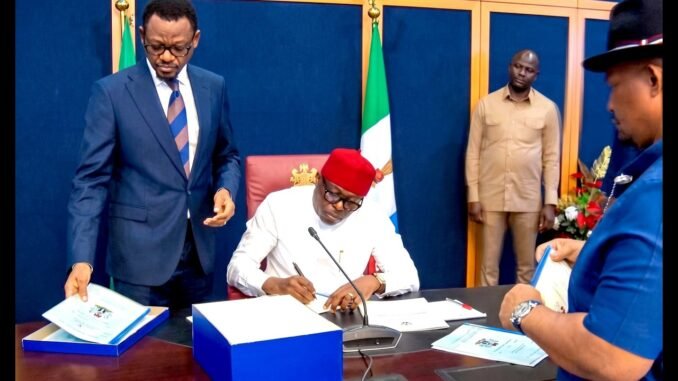

Summary: The Rivers State House of Assembly has set up an Ad-Hoc Committee to investigate how much state government money has flowed into PAMO University of Medical Sciences — a private institution linked to former governor Peter Odili — since it was founded. Here’s everything you need to know.
The Rivers State House of Assembly is not taking things lightly this time around. Lawmakers have constituted an Ad-Hoc Committee to dig deep into the funds that have been channelled from the state government’s coffers to PAMO University of Medical Sciences (PUMS) — a private institution widely associated with former Rivers State Governor, Peter Odili — since the university first opened its doors.
For many Rivers people and Nigerians watching closely, this development raises one big question: Why should taxpayers’ money be going into a privately-owned university?
What Is PAMO University of Medical Sciences?
PAMO University of Medical Sciences, commonly known as PUMS, is a private medical university located in Port Harcourt, Rivers State. The institution bears the initials of Peter Agbaghara Medical Organisation (PAMO), a healthcare brand founded by former Governor Peter Odili and his wife, Dr. Mary Odili — who also serves as a Justice of the Supreme Court of Nigeria.
Since its establishment, the university has positioned itself as a specialist medical institution aimed at training healthcare professionals. Sounds noble enough — but the controversy here is not about the university’s academic mission. It is about the source of its funding.
Why Are Lawmakers Raising Eyebrows?
The Rivers State House of Assembly’s decision to probe this matter suggests that a significant amount of government money — belonging to the good people of Rivers State — may have been released to this private institution without proper legislative oversight or justification.
In a country like Nigeria, where public universities are struggling with inadequate funding, dilapidated infrastructure, and an almost annual cycle of ASUU strikes, the idea that a state government could be bankrolling a private university owned by a politically connected family is enough to make any concerned citizen’s blood boil.
The Ad-Hoc Committee is expected to trace every kobo released to PUMS from the state treasury and determine:
– How much has been disbursed since the university was established
– The legal basis — if any — for such allocations
– Whether due process was followed in approving and releasing those funds
– Who authorised the payments at the executive level
The Bigger Picture: Accountability in Rivers State Politics
This probe is coming at a time of heightened political tension in Rivers State, where the relationship between Governor Siminalayi Fubara and his predecessor-turned-political-rival, Nyesom Wike, has kept the state in the national spotlight for months. Peter Odili, though largely out of the active political trenches, remains a towering figure in Rivers politics — and his family’s ties to the PAMO brand make this investigation politically significant.
Whether this probe is driven by genuine legislative oversight or is part of the broader political chess game playing out in Port Harcourt is a conversation Nigerians are already having on social media and in beer parlours from Mile 1 Market to GRA Phase 2.
But regardless of the political undertones, the principle remains valid: public funds must be accounted for. Every naira released from a state government’s treasury must serve the public interest — not private individuals or institutions, no matter how influential.
What Happens Next?
The Ad-Hoc Committee is expected to summon relevant government officials, review financial records, and eventually present its findings to the full House. If significant misappropriation is uncovered, it could trigger further legislative or even legal consequences.
Rivers people — and indeed all Nigerians — will be watching to see whether this probe leads to real accountability or quietly fizzles out the way many such committees have in the past.
One thing is clear: in Nigeria’s current economic climate, where millions are struggling and state governments are crying about dwindling federal allocations, no naira of public money should find its way into private pockets without scrutiny. The Rivers Assembly deserves credit for asking the hard questions — now they must follow through.
Visit buzzUp9ja for more updates
Be the first to comment