
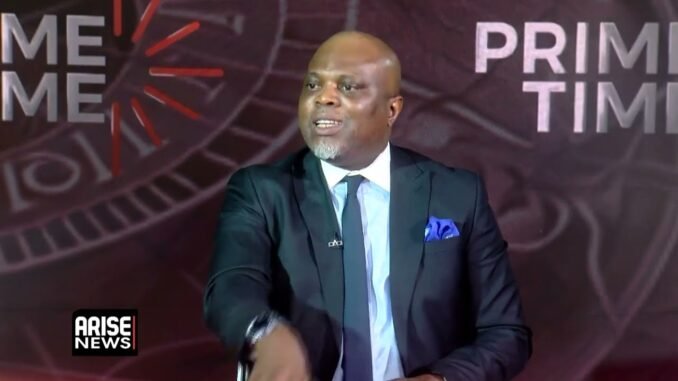

A Presidential aide and a TV anchor locked horns on live television — and Nigerians on social media had a lot to say about it.
What was supposed to be a straightforward economic discussion on Arise TV quickly turned into appointment television on Saturday, September 5, 2026, when Special Adviser to the President on Economic Matters, Tope Fasua, pushed back hard against an anchor who dared to correct him mid-interview.
The drama? A factual disagreement over whether Glovo — the popular food and delivery app many Nigerians use to order everything from jollof rice to groceries — is a Nigerian company.
Spoiler alert: it is not.
—
How the Tension Started
The interview had been sailing along smoothly until Fasua, while making a point about Nigeria’s growing digital economy, reportedly described Glovo as a Nigerian company. The anchor, doing her job, stepped in to correct the record — pointing out that Glovo is actually a Spanish company, founded in Barcelona in 2015.
For many viewers, that correction would have been a routine moment. But Fasua was not having it.
Rather than take the correction in stride — the way most guests on live television are expected to — the Presidential aide turned the moment into a conversation about manners, telling the anchor pointedly: “It’s a bit rude to your guest.”
—
A Thin Skin in the Hot Seat
Now, here is where many Nigerians raised an eyebrow — or two.
Fasua is not just any guest. He is a Special Adviser to the President on Economic Matters. Getting the ownership and origin of major companies operating in Nigeria’s economy right is, arguably, part of the job description. When a public official makes an inaccurate claim on live television, it is not rudeness for a journalist to correct it — it is journalism.
The anchor was not insulting him. She was not mocking him. She simply stated a fact.
Yet, the response was a rebuke about etiquette.
—
Nigerians React
As you can imagine, social media did not let this one slide. Twitter (now X) and Instagram comment sections lit up with reactions ranging from amusement to outright frustration.
Many Nigerians sided firmly with the anchor, arguing that holding public officials accountable — even on something as seemingly minor as the nationality of a delivery company — is exactly what the press is supposed to do.
Others pointed out the irony of a Presidential economic adviser being unfamiliar with the background of one of the most visible tech companies currently operating in Nigerian cities like Lagos and Abuja.
A few voices, however, felt the anchor could have handled the correction more diplomatically — though the majority sentiment appeared to be that facts are facts, and no amount of seniority changes them.
—
Why This Matters Beyond the Drama
Beyond the entertaining back-and-forth, this incident touches on something important in Nigeria’s media landscape — the relationship between power and the press.
For too long, many powerful figures in Nigeria have walked into television studios expecting soft questions, nods of agreement, and zero pushback. The idea that a journalist correcting a factual error is being rude reflects a broader discomfort some officials have with being held to account in public.
A healthy democracy needs a press that is willing to say, “Actually, sir, that is not correct” — even when the person on the other side of the table holds a Presidential appointment.
Arise TV’s anchor did exactly that. Whether you agree with her delivery or not, the substance of her correction was accurate.
—
The Glovo Question
For context, Glovo entered the Nigerian market and quickly became a household name in major urban centres, riding the wave of Nigeria’s booming food delivery culture. Naija people love their food delivered — from mama put classics to continental cuisine — and Glovo tapped right into that appetite.
But being popular in Nigeria does not make a company Nigerian. MTN is South African. Shoprite, before its exit, was South African. Bolt is Estonian. And Glovo is Spanish.
These are the kinds of distinctions that matter when we are having conversations about foreign direct investment, local content policies, and what it truly means to grow a homegrown Nigerian tech economy.
—
The Bottom Line
Tope Fasua’s reaction on Arise TV was, at best, a moment of thin-skinned defensiveness and, at worst, a troubling signal about how some government officials view media scrutiny.
Nigerian journalists — especially those covering economic and political affairs — deserve the space to do their jobs without being made to feel that asking questions or correcting errors is an act of disrespect.
As for the anchor? She stood her ground. And for that, many Nigerians are clapping.
What do you think? Was the Arise TV anchor out of line, or was Tope Fasua being oversensitive? Drop your thoughts in the comments below.
For more information, check buzzUp9ja
Be the first to comment