
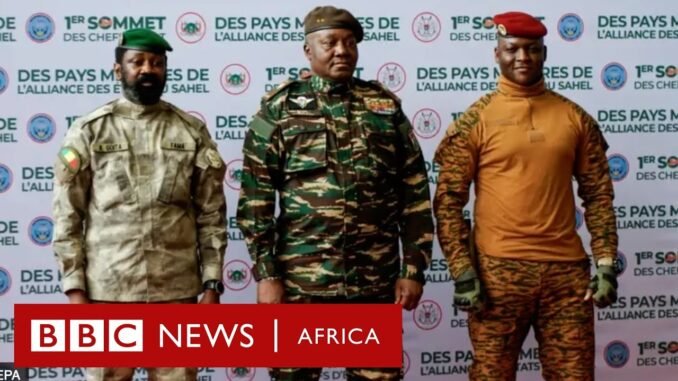

Summary: The Nigerian Presidency has spoken out on how the departure of Burkina Faso, Mali, and Niger from ECOWAS is damaging regional integration — and what it means for the rest of us in West Africa.
—
If you have been following developments in West Africa recently, you will know that something significant has shifted in our regional politics. The Alliance of Sahel States — made up of Burkina Faso, Mali, and Niger — formally turned their backs on the Economic Community of West African States (ECOWAS), and according to the Nigerian Presidency, the consequences are already being felt across the bloc.
Let us break down what this means, why it matters, and how ordinary West Africans — including Nigerians — stand to feel the impact.
—
A Blow to the Heart of Regional Integration
ECOWAS has long been the backbone of West African cooperation. From free movement of persons to trade agreements and collective security arrangements, the bloc was designed to make life better for over 400 million people across the region. But with three member states walking out, the Nigerian Presidency has confirmed what many analysts feared — key mechanisms for regional integration have been significantly weakened.
Think of it like this: imagine the South-West geopolitical zone suddenly deciding to operate independently of Nigeria’s federal structure. The remaining zones would still function, but the cracks would show — in trade, in security, in movement of people and goods.
That is essentially what is happening at the ECOWAS level right now.
—
Nigeria’s Position: We Are Concerned
As the largest economy in West Africa and the country that contributes the most to ECOWAS operations — both financially and diplomatically — Nigeria has a lot at stake here. The Nigerian Presidency has not minced words about the situation, describing the exit of the three Sahel nations as a major challenge to cooperation in the sub-region.
Nigeria has historically played the role of “big brother” in West African affairs — sometimes welcomed, sometimes resented — but always central. With Burkina Faso, Mali, and Niger now operating under military juntas and aligning more closely with Russia through the Wagner Group (now rebranded as Africa Corps), the geopolitical dynamics of our neighbourhood have shifted dramatically.
—
What Does This Mean for Ordinary Nigerians?
You might be wondering: “This sounds like something for diplomats and professors. How does it affect me in Lagos, Kano, or Enugu?”
Fair question. Here is the honest answer:
– Security concerns are real. The Lake Chad Basin and Nigeria’s North-West and North-East borders are already flashpoints for terrorism and banditry. A fragmented ECOWAS means less coordinated intelligence sharing and military cooperation to tackle groups like Boko Haram and ISWAP.
– Trade routes are affected. Many Nigerian traders — especially those dealing in goods that move through Niger Republic into North Africa — are already feeling the pinch from the political instability in the Sahel corridor.
– The ECOWAS passport and free movement protocol become harder to enforce when three countries are operating outside the framework entirely.
—
Can ECOWAS Survive and Recover?
Despite the setback, ECOWAS is not finished. The bloc still has 12 member states and retains significant institutional weight. However, experts argue that real work needs to be done to address the underlying grievances that pushed these countries away in the first place — feelings of being dominated by larger powers, frustration with conditional aid, and demands for faster democratic transitions.
Many citizens in Burkina Faso, Mali, and Niger actually supported the coups in their countries, viewing the military takeovers as liberation from what they saw as corrupt, Western-backed governments. That is a message ECOWAS cannot afford to ignore.
—
The Road Ahead
The Nigerian Presidency’s statement is a clear signal that Abuja understands the gravity of the situation. But acknowledgement alone is not enough. What West Africa needs now is creative, patient, and genuinely inclusive diplomacy — the kind that addresses real grievances rather than simply demanding compliance.
ECOWAS was built on the dream of a united, prosperous West Africa. That dream is worth fighting for — not with threats or sanctions that hurt ordinary people, but with dialogue, respect, and a genuine commitment to the common good.
As Nigerians, we have always known that no condition is permanent. The question is whether our leaders — and the leaders of the Sahel states — have the wisdom and the will to find their way back to the table.
—
What do you think about the ECOWAS crisis? Should Nigeria take a harder or softer line with the Sahel states? Drop your thoughts in the comments below.
Follow for more international news on buzzUp9ja
Be the first to comment