
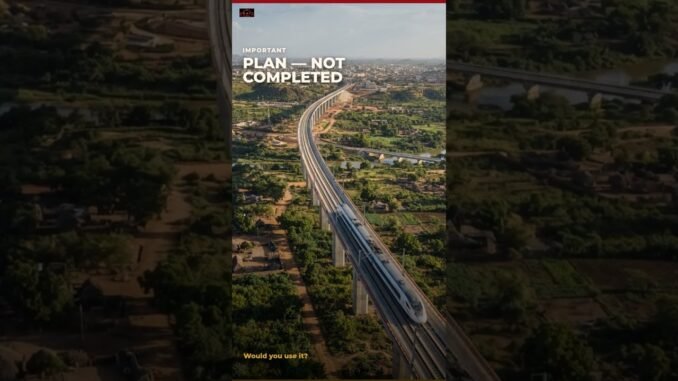

Forget the Lagos-Ibadan Expressway go-slow. Forget the agony of overnight bus journeys from the Southwest to the Northeast. If the Federal Government’s latest announcement becomes reality, Nigerians could soon be zipping from Lagos all the way to Maiduguri at a jaw-dropping 360 kilometres per hour.
Yes, you read that correctly. Three hundred and sixty kilometres per hour — on Nigerian soil.
—
What Exactly Is the FG Planning?
The Federal Government has announced ambitious plans to develop a high-speed rail line that will connect Lagos, Nigeria’s commercial heartbeat, to Maiduguri, the capital of Borno State in the far Northeast. The Permanent Secretary at the Ministry of Transportation revealed the plan, signalling that this is not just another one of those projects that gets announced and quietly disappears into the budget void.
At peak speeds of 360km/h, this rail line would rank among the fastest train services on the African continent — putting Nigeria in the same conversation as countries like Morocco, which currently operates Africa’s only high-speed rail service.
—
Why This Matters for Everyday Nigerians
Let’s put this into perspective. A road trip from Lagos to Maiduguri can take anywhere from 24 to 36 hours — and that’s if the roads are cooperating and there are no security concerns along the way. Many Nigerians travelling that route currently rely on connecting flights, which are expensive and not always reliable.
A high-speed rail connection would:
– Slash travel times dramatically, potentially reducing the journey to just a few hours
– Boost commerce between the South and the Northeast, opening up new trade corridors
– Create thousands of jobs — from construction to operations and maintenance
– Improve security in the Northeast by increasing connectivity and economic activity in the region
– Reduce pressure on Nigerian roads and domestic airlines
For market traders, students, civil servants, and families separated by distance, this could genuinely be life-changing.
—
The Route: A Journey Through Nigeria’s Soul
A Lagos-to-Maiduguri rail line would pass through some of Nigeria’s most significant cities and states. Depending on the final route alignment, the train could potentially serve communities across Lagos, Ogun, Oyo, Osun, Ekiti or Kogi, Benue, Taraba, Adamawa*, and finally *Borno State.
That is literally the length and breadth of Nigeria — North to South, Southwest to Northeast — stitched together by steel and speed.
—
Can Nigeria Actually Pull This Off?
Now, let’s have the honest conversation that every sharp Nigerian will be thinking: “We’ve heard these announcements before.”
And fair enough — Nigeria has a complicated relationship with infrastructure promises. From abandoned expressways to rail projects that stalled mid-track, skepticism is not just understandable, it is earned.
However, there are reasons to cautiously watch this one:
– High-speed rail is a global priority, attracting significant investment from China, the European Union, and international development banks, all of whom have shown interest in African infrastructure
– Nigeria already has existing standard gauge rail investments along the Lagos-Ibadan and Abuja-Kaduna corridors that show the country can execute rail projects
– The geopolitical importance of connecting the Northeast — long isolated by insurgency and underdevelopment — gives this project strategic weight beyond just transportation
The key questions Nigerians will rightly ask are: Who is funding it? What is the timeline? And which contractors will be involved?
—
The Bigger Picture: Africa’s Infrastructure Race
Nigeria is not operating in a vacuum. Across the continent, countries are investing heavily in modern rail infrastructure to drive economic growth. Ethiopia has its Addis Ababa light rail. Kenya has the Standard Gauge Railway. Egypt is building a high-speed network. And Morocco’s Al Boraq train already connects Casablanca to Tangier at high speed.
For Africa’s largest economy and most populous nation, a world-class high-speed rail line is not a luxury — it is a necessity.
—
What Happens Next?
Details on funding, contractors, and a definitive timeline are still expected to be made public. Nigerians will be watching closely — and rightly demanding transparency, accountability, and delivery.
For now, the vision is bold. A Nigeria where you can board a train in Lagos in the morning and arrive in Maiduguri by afternoon is a Nigeria that works differently — more connected, more competitive, and more confident in its own potential.
And honestly? That Nigeria sounds like one worth building.
Stay with us for updates as this story develops. Share this article with someone who needs to see what could be possible for our country.
For more information, check buzzUp9ja
Be the first to comment