
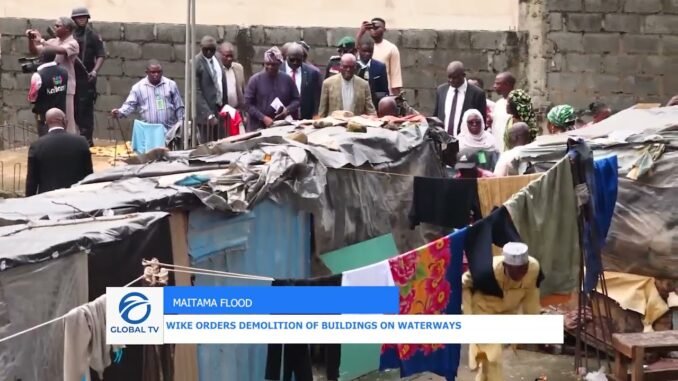

Summary: FCT Minister Nyesom Wike has ordered the immediate demolition of houses built on Abuja’s waterways as flooding concerns rise. Here’s everything you need to know.
If you have ever watched helplessly as floodwaters swallowed your street, your car, or worse — your home — then you already understand why this story matters. FCT Minister Nyesom Wike is not mincing words this time: houses built on designated water channels in Abuja must come down, and he is not taking “but sir” for an answer.
Wike Drops the Hammer
In his characteristic no-nonsense style, Minister Nyesom Wike has issued a stern directive ordering the immediate demolition of any structure obstructing waterways across the Federal Capital Territory. For those who built on drainage channels and flood corridors hoping the government would look the other way — your time, it seems, has run out.
“Heaven will not fall,” Wike reportedly declared, signalling that no amount of political pressure, big connections, or last-minute court injunctions would stop the exercise. If you know Nigerian politics, you know that is a very bold statement to make — and an even bolder one to act on.
Why This Is a Big Deal
Abuja is Nigeria’s showcase city — the face we present to the world. Yet, every rainy season, the nation’s capital embarrassingly transforms into a network of rivers and lakes where roads used to be. Estates flood. Cars get submerged. Families are displaced. And every year, the same question is asked: how did we get here?
The answer, more often than not, points back to the same problem — illegal and poorly regulated construction on natural waterways and drainage channels. When developers or individuals block the paths that water is supposed to travel, the water does not simply disappear. It finds another way. And that way is usually through your living room.
The Pattern We Know Too Well
This is not a uniquely Abuja problem. From Lagos Island to Port Harcourt, from Kano to Benin City, Nigerians have watched helplessly as decades of building on waterways, blocking drainages with refuse, and ignoring town planning regulations have turned annual rainfall into annual disasters.
In Lagos, floods have claimed lives and billions in property. In Bayelsa and Anambra, entire communities have been submerged. Even the wealthy neighbourhoods of Abuja — Maitama, Wuse, Gwarinpa — have not been spared when the rains come heavy.
The root cause? A culture of impunity in construction, weak enforcement of building codes, and the unfortunate Nigerian habit of hoping that e go be — until it is no longer okay.
Will the Demolition Actually Happen?
Here is where many Nigerians will raise an eyebrow — and rightly so. Nigeria has a long and storied history of government announcements that never quite translate into action. Deadlines are given, extensions are granted, court orders are obtained, and before you know it, the rainy season is over and everyone forgets until next year.
But Wike, love him or loathe him, has a reputation for following through on demolitions. His tenure has already seen several high-profile structures come down in Abuja. Whether that energy extends to politically connected property owners who may have built on these waterways remains the real test.
Because let us be honest — not every house on a waterway belongs to a poor man who did not know better. Some of those structures belong to people with phone numbers that could make a minister pause.
What This Means for Abuja Residents
If you live in Abuja and your property sits close to a drainage channel or natural waterway, now is the time to verify your building approvals and confirm you are not in the demolition crosshairs. The FCT Administration has made clear that structures obstructing water flow will be removed — with or without the owners’ cooperation.
For the rest of us watching from a distance, this directive is a reminder that urban planning is not just bureaucracy — it is the difference between a city that functions and one that drowns every July and August.
The Bigger Picture
Nigeria needs a serious national conversation about flood management, climate adaptation, and urban planning. With climate change making rainfall patterns increasingly unpredictable and intense, the margin for error is shrinking. We cannot keep building on waterways and then act surprised when water does what water has always done — flow.
Wike’s order, if properly executed, is a step in the right direction. But it needs to go beyond Abuja. State governors, local government chairmen, and town planning authorities across the country need to take similar decisive action — before the next rainy season turns another Nigerian city into a swimming pool.
One thing is certain: the rain will come again. The only question is whether we will be ready for it.
Explore more on buzzUp9ja
Be the first to comment