
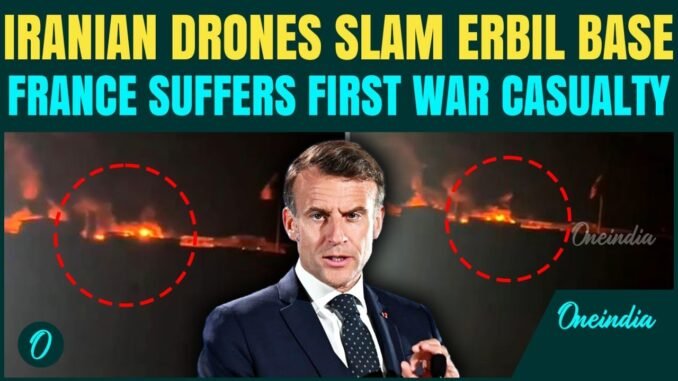

Summary: A coordinated drone attack on a joint special forces base in Erbil has injured American soldiers, with UK defence officials raising concerns about potential Russian involvement in Iran’s military tactics.
In a troubling development that could reshape Middle East security dynamics, a joint special forces base in Erbil, Iraq, came under heavy drone assault on Wednesday night, leaving several American soldiers injured and sparking international concerns about Russia’s potential role in Iran’s expanding military capabilities.
The Attack: What We Know
The coordinated assault involved a swarm of Iranian drones targeting the strategic facility used by coalition special forces operating across the region. While defence systems managed to intercept two incoming drones, several others penetrated the compound’s defences, inflicting damage and causing casualties among American personnel.
Guy Foden, a commander at the United Kingdom Permanent Joint Headquarters, confirmed that British forces stationed at the base actively participated in defending against the attack. Fortunately, no British soldiers were harmed during the incident. Nick Perry, who oversees global operations for the UK Ministry of Defence, later clarified that the American casualties sustained non-life-threatening injuries.
The targeted facility sits near highly sensitive locations, including the United States Consulate in Erbil and military installations around Erbil International Airport, making it a strategically significant coalition stronghold in northern Iraq.
The Russia Connection: Growing Concerns
Perhaps the most alarming aspect of this attack isn’t just its execution, but the possibility that Moscow may be indirectly supporting Iran’s military operations. Speaking from London after receiving operational briefings at the Northwood headquarters, UK Defence Secretary John Healey raised eyebrows when he suggested that Russian influence might be evident in Iran’s drone warfare tactics.
“We are examining components from drones used in these attacks to determine whether foreign technology or parts, potentially linked to Russia, were involved,” Healey stated during his briefing.
This isn’t merely speculation. British military analysts are actively investigating whether Iranian drones incorporate Russian technology or tactical doctrine—a collaboration that could signal a dangerous new chapter in Middle East conflicts.
Healey also pointed to a troubling financial incentive for Russian involvement: rising oil prices triggered by regional instability. As global energy markets react to Middle Eastern tensions, oil prices climb—directly benefiting Russia’s economy and potentially funding Moscow’s ongoing war in Ukraine. It’s a cynical calculation that could see Putin leveraging Middle East chaos for economic and strategic gain.
Britain’s Response: Ramping Up Regional Defence
The UK hasn’t remained passive in the face of these escalating threats. British military operations across the Middle East have intensified significantly, with Royal Air Force assets deployed to protect allied forces and regional partners.
Eurofighter Typhoon and F-35B Lightning II jets have been conducting defensive patrols over Jordan, Qatar, and the United Arab Emirates. According to military sources, British pilots have logged more than 300 operational hours, successfully intercepting and destroying multiple drones that threatened coalition bases throughout the region.
This robust British response demonstrates the seriousness with which London views the Iranian drone threat—and the broader implications of potential Russian-Iranian military cooperation.
Iran’s Vow of Continued Retaliation
The attack comes amid spiralling tensions following the death of Iran’s previous supreme leader during joint US-Israeli strikes. His successor, Mojtaba Khamenei, wasted no time in promising revenge.
In a televised statement that left little room for interpretation, Khamenei declared that Iran would not hesitate to avenge those killed in the strikes. More ominously, he warned that Iranian forces would continue targeting foreign military bases across the region, which Tehran views as instruments of American power projection in the Middle East.
This explicit threat suggests that Wednesday’s drone attack may be merely the opening salvo in a prolonged campaign against coalition facilities throughout Iraq, Syria, and possibly beyond.
Global Implications: The Strait of Hormuz Factor
Beyond the immediate security concerns for military personnel, this escalation carries profound implications for the global economy. The Strait of Hormuz—through which roughly one-fifth of the world’s oil supplies pass daily—sits at the heart of this volatile region.
Any significant disruption to shipping through this narrow waterway could send energy prices soaring worldwide, affecting economies from Asia to Africa to Europe. For Nigeria, heavily dependent on oil revenues, the ripple effects of sustained Middle East conflict could impact everything from government budgets to fuel prices at local filling stations.
What This Means Moving Forward
The drone strike on Erbil represents more than just another attack in the Middle East’s ongoing conflicts. It potentially signals:
1. A new level of Iranian military sophistication, possibly enhanced by Russian technology or training
2. An expanding shadow alliance between Moscow and Tehran that could complicate Western security calculations
3. The beginning of a sustained Iranian campaign against coalition forces in Iraq and neighbouring countries
4. Economic volatility that could affect global oil markets and energy security
As British and American forces continue defending against these threats, the international community watches nervously to see whether this conflict will remain contained or spiral into something far more dangerous.
For now, coalition forces remain on high alert, defence systems stay active, and analysts continue examining drone debris for clues about the extent of Russian involvement—answers that could reshape how the West approaches both the Iranian threat and Moscow’s growing influence across the Middle East.
For more information, check buzzUp9ja
Be the first to comment