
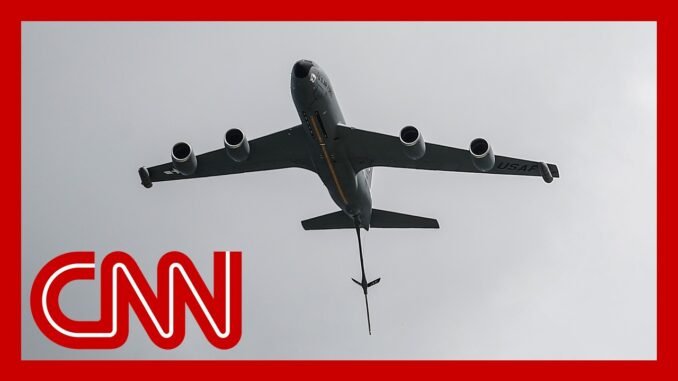

Summary: A US KC-135 Stratotanker has crashed in western Iraq during Operation Epic Fury, amid rising tensions between America and Iran that are affecting global oil prices and shipping routes.
A United States military refuelling plane has crashed in western Iraq, sparking concerns about possible casualties among American servicemen deployed in the volatile Middle East region.
The incident, which occurred during what the US military calls “Operation Epic Fury,” involved a Boeing KC-135 Stratotanker—a specialised aircraft designed to refuel fighter jets and bombers while they’re airborne on missions.
According to the United States Central Command (CENTCOM), the crash happened after some form of incident involving two aircraft operating in what they described as “friendly airspace.” Military officials have emphasized that there was no hostile fire involved in the crash, suggesting it may have been an accident rather than enemy action.
Status of Crew Members Remains Unknown
As of this report, US military authorities have not confirmed whether the crew members aboard the tanker survived the crash or provided details about casualties. The aircraft went down in western Iraq, an area that has seen increased military activity in recent weeks.
This incident comes at a particularly tense moment in the region, as the United States and Israel have intensified their military operations against Iranian targets across the Middle East.
Trump Vows Continued Action Against Iran
US President Donald Trump has maintained a hardline stance against Tehran, describing Iran as an “evil empire” in recent statements. Taking to his Truth Social platform, Trump reiterated America’s commitment to preventing Iran from developing nuclear weapons and what he termed the country’s destabilizing activities in the region.
“We will not allow Iran to acquire nuclear capabilities,” Trump declared, signaling that military pressure on Tehran will continue despite the risks and costs involved.
The Israeli military has also ramped up its involvement, recently announcing strikes on the Taleghan compound—a facility Israel claims was being used by Iran to develop nuclear weapons capabilities. The coordinated US-Israeli campaign represents one of the most significant military confrontations with Iran in recent years.
Oil Prices Surge as Shipping Routes Come Under Threat
For Nigerians and people worldwide, the conflict is having real economic consequences. Global oil prices are once again approaching the $100-per-barrel mark, driven by fears of supply disruptions from one of the world’s most critical energy corridors.
The Strait of Hormuz, a narrow waterway through which roughly one-fifth of global oil supplies pass daily, has become a flashpoint. Multiple cargo ships and oil tankers have been attacked in recent days near the strait, including vessels near Iraq and off the coast of the United Arab Emirates.
These disruptions to global shipping could affect fuel prices in Nigeria and other oil-importing nations, even as Nigeria itself remains a major oil producer. The volatility in international markets often translates to higher costs for refined petroleum products, which Nigeria still imports in significant quantities.
Iran Sets Conditions for Peace
Iranian President Masoud Pezeshkian has outlined potential conditions for ending the hostilities, though his proposals appear unlikely to be accepted by Washington or Tel Aviv in their current form.
Pezeshkian stated that Iran could consider halting military activities if its “legitimate rights” were recognized internationally, if reparations were paid for damages caused by recent strikes, and if guarantees were provided against future attacks.
However, the Iranian president acknowledged that he does not have the final say on such matters. Ultimate authority over war and peace decisions in Iran rests with the country’s Supreme Leader, Mojtaba Khamenei, who has shown little inclination toward compromise with the United States.
Wider Regional Implications
The escalating conflict has transformed the Gulf region into one of the world’s most dangerous areas for both military personnel and commercial shipping. The recent attacks on tankers and cargo vessels highlight how quickly regional conflicts can disrupt global trade and energy supplies.
For Nigeria, which maintains diplomatic relations with both Iran and the United States while depending heavily on oil revenues, the situation presents complex challenges. Any prolonged disruption to global energy markets could affect Nigeria’s oil exports and government revenues, even as higher prices might temporarily boost income.
As the situation continues to develop, the crash of the US tanker in Iraq serves as a stark reminder of the human costs of military operations, even beyond direct combat. Families of the crew members aboard the downed aircraft await news of their loved ones’ fate, while the broader conflict shows no signs of de-escalation.
The coming days will likely prove critical in determining whether the situation spirals further or if diplomatic channels can find a path toward reducing tensions in this strategically vital region.
Check buzzUp9ja for more updates
Be the first to comment