
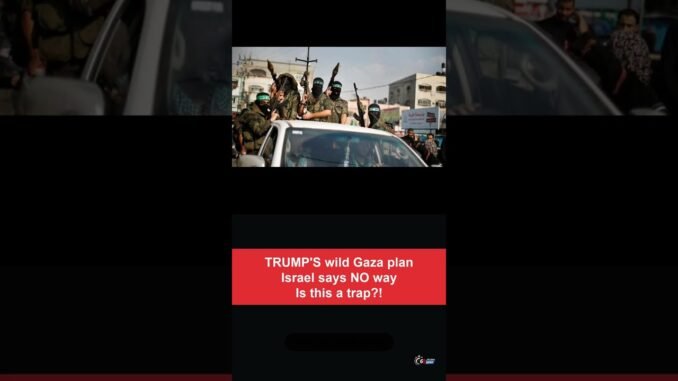

Summary: Israeli PM Benjamin Netanyahu has flatly rejected Donald Trump’s 15-point peace plan for Gaza, insisting that Israeli forces will not pull out until Hamas completely disarms. Here’s what this means for the region — and why it matters to Africa and beyond.
—
There’s a serious rift brewing between two of the world’s most powerful allies — and it’s happening right in the open, for everyone to see.
Israeli Prime Minister Benjamin Netanyahu has reportedly thrown cold water on a 15-point plan proposed by United States President Donald Trump aimed at ending the devastating conflict in Gaza. According to reports, Netanyahu is standing firm: Israeli troops are not going anywhere until Hamas — the Palestinian militant group controlling Gaza — completely lays down its weapons.
This is not small talk. This is one of the closest alliances in global geopolitics showing serious cracks, and the consequences could ripple far beyond the Middle East.
—
So, What Exactly Happened?
Trump, known for his bold, transactional approach to diplomacy, reportedly put forward a detailed 15-point framework intended to chart a path toward ceasefire and some form of stability in Gaza. The plan was, by all accounts, an attempt by the Trump administration to assert itself as a deal-maker in a conflict that has claimed tens of thousands of lives and displaced millions of Palestinians.
But Netanyahu? He reportedly looked at the plan and said, in so many words — “Not so fast.”
The Israeli PM’s position is clear: Hamas must be fully disarmed before any significant Israeli withdrawal happens. For Netanyahu, anything short of that is a security risk Israel simply cannot afford.
—
Why This Is a Big Deal
Here in Nigeria, we understand what it means when powerful friends fall out. Think of it like two big men in the same business who suddenly stop agreeing — everything around them feels the tension.
The United States has historically been Israel’s biggest backer — providing billions in military aid, diplomatic cover at the United Nations, and political support across administrations. For Israel to publicly push back against a Trump proposal is unusual, to say the least.
Trump, who positioned himself during his campaign as the man who could end wars and broker deals, now faces the embarrassment of being rejected by the very ally he has championed so strongly.
—
What Does Hamas Have to Say?
Hamas, for its part, has long refused to disarm, viewing armed resistance as central to its political identity and strategy. Expecting them to simply hand over their weapons is, according to many analysts, about as realistic as asking a soldier to fight with no ammunition — it goes against everything they stand for, rightly or wrongly.
This creates what diplomats call a stalemate — both sides deeply entrenched, with civilians in Gaza continuing to bear the devastating cost.
—
Why Nigerians Should Pay Attention
Some people may ask — “Why should this matter to us in Nigeria?”
Here’s the thing: global conflicts don’t stay in their corners. When powerful nations like the US and Israel clash over foreign policy, it affects:
– Oil prices — The Middle East remains a critical player in global energy markets, and instability there has historically sent fuel prices climbing worldwide, including at our pumps here in Nigeria.
– Global diplomacy — Nigeria, as Africa’s most populous nation and a significant voice in the African Union, has interests in how international conflicts are resolved. Peace in the Middle East affects trade, migration, and security across continents.
– The humanitarian lens — Millions of Palestinians are caught in the crossfire. As a nation that has experienced its own internal conflicts and displacement, Nigerians understand the human cost of war better than most.
—
The Bigger Question: Can Anyone Broker Peace?
The rejection of Trump’s plan raises a deeper, more uncomfortable question — is peace in Gaza even achievable right now?
With Netanyahu digging in his heels, Hamas refusing to disarm, and now a visible tension between Israel and its most powerful ally, the path to any lasting resolution looks increasingly narrow.
What’s clear is that the people of Gaza — ordinary men, women, and children — continue to live through conditions that the United Nations has described as catastrophic. And while world leaders trade political punches, real lives hang in the balance.
—
Final Word
The rejection of Trump’s Gaza plan by Netanyahu is more than a diplomatic disagreement — it’s a signal that this conflict is far from over, and that even the most powerful friendships in geopolitics have their limits.
As Nigerians, we must stay informed, think critically, and hold onto the belief that peace — no matter how distant it seems — is always worth pursuing.
Because at the end of the day, whether in Lagos, Gaza, or Washington DC, it is ordinary people who pay the highest price for the decisions of powerful men.
—
Stay informed. Share this article with someone who needs to understand what’s happening in the world today.
Stay connected on buzzUp9ja for more info
Be the first to comment