
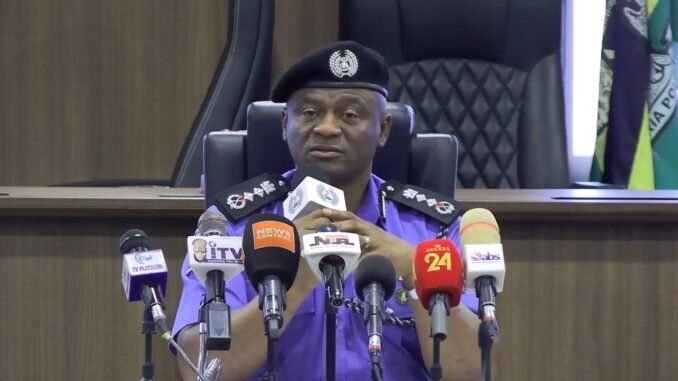

Summary: IGP Olatunji Disu has revealed that the committee behind Nigeria’s proposed state police framework studied policing models from India, the US, and Pakistan before crafting a locally tailored system. Here’s what you need to know.
—
Nigeria’s journey towards establishing a state police system just got more interesting. The Inspector-General of Police, IGP Olatunji Disu, has revealed that the committee responsible for developing the framework for the proposed state police did not just sit in Abuja and cook up ideas from thin air — they did their homework, studying how countries like India, the United States of America, and Pakistan run their decentralised policing systems.
No Be Guesswork — They Studied Global Models
According to IGP Disu, the committee took a thorough look at how other large, diverse nations manage policing across different states and regions before putting together a framework suitable for Nigeria. This approach signals a deliberate effort to learn from both the successes and pitfalls of policing structures in countries that, like Nigeria, deal with the complexities of governing a large, multi-ethnic population.
India, for instance, operates a system where each state maintains its own police force under the supervision of the central government. The United States, on the other hand, is well known for its highly decentralised law enforcement structure, where local, state, and federal agencies operate with distinct jurisdictions. Pakistan, sharing certain historical and structural similarities with Nigeria, also provided useful reference points for the committee.
Why This Matters for Every Nigerian
For the average Nigerian — whether you are a trader in Onitsha Main Market, a civil servant in Abuja, or a farmer in Benue — the question of state police is not just a political debate. It is about whether the police that patrol your street will understand your language, know your community, and respond faster when trouble comes.
One of the biggest criticisms of the current centralised police system is that it is too far removed from grassroots realities. A police officer posted from Lagos to Zamfara, or from Kano to Rivers State, may struggle to connect with local communities, understand local dialects, or navigate the cultural nuances that are often critical in resolving conflicts.
State police, in theory, would address this by allowing each state government to recruit, train, and deploy officers who are deeply familiar with their local environments.
The Concerns Still on the Table
Of course, not everyone is clapping. Critics — and there are many — have raised genuine concerns about the potential for abuse. In a country where godfatherism and political thuggery are not strangers to our governance landscape, handing governors direct control over armed police forces is not something to take lightly. The fear is real: would state police become tools for political intimidation, especially during election seasons?
These are questions the framework must answer clearly and convincingly before Nigerians can fully trust the system.
What Happens Next?
IGP Disu’s disclosure suggests that significant groundwork has already been laid. The fact that global models were studied and adapted indicates that this is not just political talk — there is a structured process underway. However, the proof, as they say, will be in the pudding.
Nigerians will be watching closely to see whether the final framework includes strong, independent oversight mechanisms, clear checks on gubernatorial powers over the police, and robust funding structures that prevent state police from becoming underpaid, poorly equipped, and ultimately ineffective — a situation we cannot afford to replicate at the state level.
—
The conversation around state police in Nigeria is far from over. As more details emerge, staying informed is the best way for citizens to hold their leaders accountable. Watch this space.
Follow for more news on buzzUp9ja
Be the first to comment