
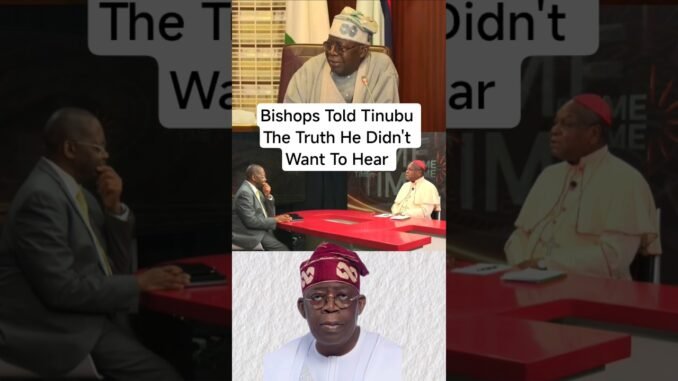

Summary: Cardinal Onaiyekan has revealed striking details of the Catholic Bishops’ closed-door meeting with President Tinubu, including the President’s surprising response when bishops raised concerns about Nigeria’s struggling economy.**
—
John Cardinal Onaiyekan, the Archbishop Emeritus of the Catholic Diocese of Abuja, has pulled back the curtain on what truly went down during the much-talked-about meeting between Nigeria’s Catholic Bishops and President Bola Ahmed Tinubu — and e be things, as we say.
According to the respected Cardinal, the bishops did not mince words when they sat across from the President. They told him plainly — the kind of straight talk that only men of God can deliver without fear — that the Nigerian economy is not working for the poor. Ordinary Nigerians are suffering. The cost of living has gone through the roof, and the masses are feeling the full brunt of the government’s economic policies.
But here is where it gets interesting.
Cardinal Onaiyekan revealed that President Tinubu made it “quite clearly” known that he did not agree with the position of the bishops. The President, it appears, sees the economic situation from a very different lens than the clergy — and indeed, from a very different lens than millions of Nigerians who are struggling daily to put food on the table.
—
When Men of God Speak, Will Power Listen?
The Catholic Bishops’ Conference of Nigeria (CBCN) is not an organisation that plays to the gallery. These are men who have spent decades serving communities across Nigeria — from the winding streets of Lagos Island to the dusty roads of Borno — and they understand grassroots suffering better than most technocrats sitting in Abuja offices.
So when Cardinal Onaiyekan, a man of enormous moral authority in Nigeria and across Africa, says the bishops told the President that “the economy is not helping the poor,” we should take that seriously. This was not opposition politics. This was pastoral concern — a spiritual father speaking truth to temporal power.
Yet the President disagreed.
—
The Bigger Picture: A Nation at a Crossroads
Let us not pretend we do not know the context. Since the removal of the fuel subsidy in 2023, Nigerians have faced some of the most punishing economic conditions in recent memory. The naira has been battered. Inflation has made the market a nightmare. A bag of rice that sold for ₦30,000 now costs more than double that in many parts of the country. Graduates are leaving Nigeria in droves — the Japa wave shows no sign of slowing down.
When bishops — men who hear confessions, who visit the sick, who counsel the broken — sit before the President and say “your policies are hurting the poor,” that is not an accusation. That is a diagnosis.
The question is: what do you do when the doctor tells you that you are sick, but you insist you are fine?
—
Onaiyekan’s Revelation: A Warning We Should Not Ignore
Cardinal Onaiyekan’s candid disclosure is significant for several reasons:
– It confirms that the meeting was not just a photo opportunity. Real, hard conversations took place.
– It shows that Nigeria’s religious leaders are willing to speak uncomfortable truths — even when those truths are unwelcome in the corridors of power.
– It raises serious questions about whether the Tinubu administration truly understands the depth of suffering at the grassroots level.
For many Nigerians, the bishops’ concerns are not abstract. They are lived experiences — skipped meals, children withdrawn from school, businesses shuttered, and dreams deferred indefinitely.
—
What Happens Next?
The Catholic Church in Nigeria commands enormous influence. With millions of faithful across the country, and a tradition of speaking truth to power that dates back through the darkest days of military rule, the CBCN is not an institution any government can afford to dismiss lightly.
Cardinal Onaiyekan and his fellow bishops have spoken. Nigeria has heard them.
Now, the real test is whether President Tinubu and his economic team will take a step back, listen beyond the boardrooms and briefing papers, and truly reckon with what ordinary Nigerians are going through.
Because at the end of the day, as we say in Nigeria — “government work na for the people.” And if the people are not feeling it, then something, somewhere, needs to change.
—
What do you think about Cardinal Onaiyekan’s revelations? Do you believe the Nigerian government is doing enough to address the economic hardship facing ordinary citizens? Drop your thoughts in the comments below.
Follow for more news on buzzUp9ja
Be the first to comment