
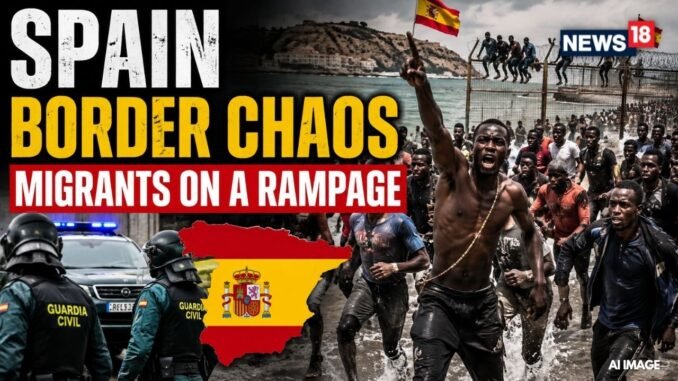

Summary: Spain has deployed its military to Ceuta after thousands of migrants from Morocco forced their way into the North African enclave, triggering a massive security response. Here’s everything you need to know.
—
The Spanish government has taken the dramatic step of deploying its military forces to Ceuta, its small North African enclave, after thousands of migrants stormed across the border from Morocco in what officials are describing as an unprecedented border crisis.
What Exactly Happened?
In scenes that shocked many across the world, thousands of migrants — many of them young men and women desperate for a better life — overwhelmed border security at Ceuta, the tiny Spanish territory sitting on the northern tip of Africa, just a stone’s throw away from the Moroccan coastline.
The sheer number of people who crossed made it nearly impossible for regular border officials to manage the situation alone, forcing Madrid to escalate its response by calling in the military.
Why Are People Crossing Into Ceuta?
For many Africans — including a significant number of West Africans — Ceuta represents something of a golden gate into Europe. Because it is Spanish territory located physically on the African continent, crossing into Ceuta is effectively crossing into the European Union without having to brave the treacherous Mediterranean Sea.
As Nigerians, we understand this reality all too well. Many of our own brothers and sisters have attempted similar dangerous journeys, driven by economic hardship, insecurity, and the search for opportunities that seem increasingly out of reach at home. The Ceuta crossing, while risky, is seen as far less deadly than attempting to cross the Mediterranean by boat — a journey that has claimed thousands of lives over the years.
Spain’s Response: Military on the Ground
The Spanish government wasted no time. Military personnel were swiftly deployed alongside police and border control agents to manage the influx and restore order at the border. Officials confirmed they were dealing with a major security situation, with resources stretched dangerously thin.
Spanish authorities began processing and, in many cases, returning migrants to Morocco, with the two countries engaging in emergency diplomatic conversations to address the crisis.
Morocco’s Role — and the Politics Behind It
Here is where things get interesting. The sudden surge of migrants did not happen in a vacuum. Relations between Spain and Morocco had reportedly been under significant strain in the days leading up to the crossing, with analysts suggesting that Moroccan border authorities — who normally play a key role in managing migration flows — may have temporarily relaxed their controls.
This is a pattern we have seen before. Migration, particularly across the Spain-Morocco corridor, is often used as a political bargaining chip between nations. When diplomatic tensions rise, border enforcement tends to mysteriously loosen. It is a brutal reality that uses desperate human beings as pawns in a geopolitical chess game.
The Human Side of the Story
Beyond the politics and the military deployments, it is important that we not lose sight of the human beings at the centre of this crisis. Many of those who crossed were:
– Young men and women fleeing poverty and lack of opportunity
– Families seeking safety and stability
– Children — some unaccompanied — who risked everything for a chance at survival
This is a story that hits close to home for many Nigerians. With Nigeria’s own economic challenges, insecurity in several regions, and youth unemployment at alarming levels, the desperation that drives people to attempt these crossings is something many of us can understand — even if we would not make the same choice.
What This Means for Africa and the World
The Ceuta crisis is a reminder of the deeper, unresolved issues facing the African continent. Until African nations — including Nigeria — can provide their citizens with security, economic opportunity, and functional governance, the pressure on Europe’s borders will not ease.
This is not simply a European problem or a Spanish problem. It is a global conversation about inequality, development, and the fundamental human desire for a dignified life.
Key Takeaways
– Spain deployed its military to Ceuta after thousands of migrants crossed from Morocco
– Ceuta serves as one of the few land borders between Africa and the EU
– The crisis has diplomatic dimensions, with Spain-Morocco relations playing a significant role
– The situation highlights the broader migration crisis driven by poverty and instability across the African continent
– Human rights organisations are calling for a compassionate and legal response to those who crossed
—
This is a developing story. As more details emerge, we will bring you the latest updates. Share your thoughts in the comments — what do you think is the real solution to Africa’s migration crisis?
Stay tuned on buzzUp9ja for more updates
Be the first to comment