
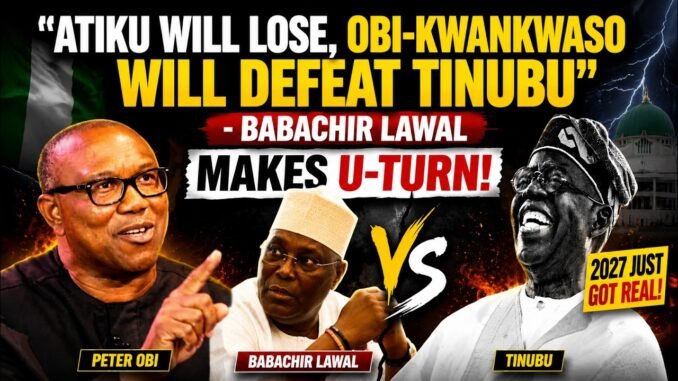

Former SGF argues that a united opposition ticket may be the strongest path to unseating the ruling party in the next general elections
—
Former Secretary to the Government of the Federation (SGF), Babachir Lawal, has stirred serious political conversation across the country with a bold declaration — a joint presidential ticket featuring Labour Party’s Peter Obi and NNPP’s Rabiu Musa Kwankwaso could be the opposition’s strongest weapon heading into the 2027 general elections.
For many Nigerians who are still nursing the wounds of a bitterly contested 2023 election, this statement is either music to their ears or fuel to an already blazing fire of political debate. Either way, Babachir Lawal — a man who has seen the corridors of power up close — is not mincing words.
—
The Alliance That Almost Was
Cast your mind back to 2023. Political analysts, market women, okada riders, and Twitter fingers alike were buzzing about the possibility of an Obi-Kwankwaso merger. The idea was simple but powerful — combine Peter Obi’s massive “Obidient” movement, which swept through the South-East, South-South, and urban centres nationwide, with Kwankwaso’s iron grip on Kano and the North-West, and you potentially have a presidential ticket that cuts across ethnic, religious, and regional lines like no other.
It never happened. And many believe that was a costly mistake.
Now, Babachir Lawal is essentially saying: don’t make the same mistake twice.
—
Why This Alliance Makes Political Sense
Nigeria’s political landscape operates on a simple but brutal logic — numbers win elections. And those numbers must be spread across enough states and geopolitical zones to satisfy both the popular vote and the constitutional threshold required by INEC.
Here is why the Obi-Kwankwaso ticket, in theory, is such a compelling proposition:
– Peter Obi demonstrated in 2023 that he could mobilise young Nigerians, urban professionals, and the Southeast/South-South bloc in a way that shocked the political establishment. His support base is passionate, tech-savvy, and deeply motivated.
– Rabiu Kwankwaso is not just a politician — he is a political institution in Kano, Nigeria’s second most populous state. His “Kwankwasiyya” movement commands fierce loyalty across the North-West. That is not something you can buy or manufacture overnight.
Together? On paper, that is a coalition that covers significant ground — from Lagos Island to Kano, from Anambra to Kaduna.
—
Babachir Lawal’s Weight in This Conversation
It is worth noting who is saying this. Babachir Lawal is not an armchair critic or a social media commentator. He served as SGF under President Muhammadu Buhari, understands the inner workings of Nigerian governance, and has not been shy about criticising his former allies when he believes it is necessary.
His endorsement of this idea — even hypothetically — carries weight precisely because he sits outside both the Labour Party and the NNPP camps. This is not a cheerleader speaking; it is a political strategist thinking out loud.
—
The Hard Questions Nigerians Are Asking
Of course, no political conversation in Nigeria is complete without the wahala. Several questions remain unanswered:
1. Who takes the presidential slot and who becomes running mate?
This is where ego and ambition have historically buried Nigerian political alliances before they even got off the ground. Both Obi and Kwankwaso ran for president in 2023. Neither is likely to step aside easily.
2. Can their supporters follow their leaders into a merger?
The “Obidient” movement, in particular, is known for its fierce independence. Many supporters backed Peter Obi as an individual, not a party structure. Whether they would accept a Kwankwaso alliance is not guaranteed.
3. What platform would they run on?
Would they merge into one party, or run as a joint ticket under one of their existing parties? These are logistical and legal questions that INEC rules would need to accommodate.
—
2027 Is Closer Than You Think
Nigerians have a habit of treating the next election as something far away — until suddenly it is upon us and the political parties are already three steps ahead. With the current economic realities — biting inflation, fuel prices that make grown men weep, and a cost of living that has turned ordinary life into a daily hustle — the appetite for a credible alternative to the ruling APC is very much alive.
The opposition, however, has a long history of snatching defeat from the jaws of victory through disunity, ego clashes, and last-minute betrayals. If Babachir Lawal’s message means anything, it is this: the time to build that coalition is now, not three weeks before election day.
—
The Bottom Line
Whether you are an Obidient, a card-carrying Kwankwasiyya member, or simply a Nigerian who wants a government that works — the conversation Babachir Lawal has reignited deserves serious attention.
A united, well-structured opposition ticket that speaks to the North and the South, to the young and the experienced, could genuinely reshape Nigeria’s political future. Whether the principals involved have the wisdom, humility, and patriotism to make it happen is another matter entirely.
As they say on the streets — e go be? Only time will tell.
What do you think? Would an Obi-Kwankwaso ticket in 2027 change the game? Drop your thoughts in the comments below.
For more information, check buzzUp9ja
Be the first to comment