
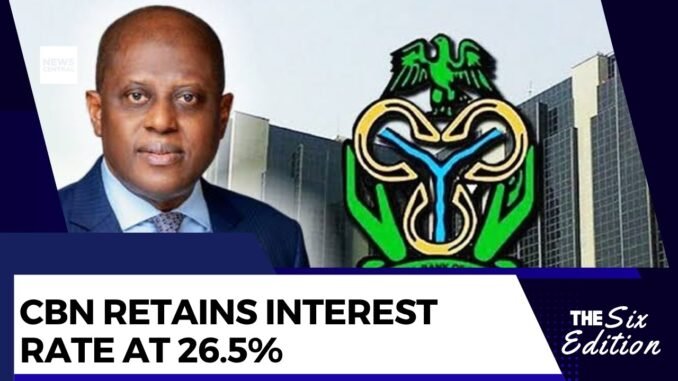

The Central Bank of Nigeria (CBN) has decided to keep things exactly where they are — at least when it comes to interest rates.
CBN Governor, Olayemi Cardoso, announced on Tuesday that the Monetary Policy Rate (MPR) — the benchmark interest rate that essentially sets the tone for borrowing and lending across the entire country — will remain unchanged at 26.5 per cent.
So, What Exactly is the MPR?
For those who may be wondering what all the fuss is about, think of the MPR as the “oga at the top” of all interest rates in Nigeria. When the CBN sets this rate, it directly influences how much commercial banks like Access, GTBank, Zenith, and others will charge you when you take a loan — whether for your business, your car, or even that plot of land you’ve been eyeing in Lekki or Asokoro.
Simply put, a higher MPR means borrowing becomes more expensive. A lower MPR means cheaper loans and more money flowing through the economy.
Why Did CBN Hold the Rate?
Retaining the MPR at 26.5% signals that the CBN is maintaining its hawkish monetary policy stance — a strategy aimed at taming inflation and stabilising the naira. Nigeria has been battling persistently high inflation, and the apex bank appears determined not to ease up just yet.
By keeping the rate high, the CBN is essentially telling commercial banks: “Credit remains tight, and we are not ready to open the floodgates just yet.”
What Does This Mean for Everyday Nigerians?
Here’s the real gist — this decision touches the lives of millions of Nigerians in ways that may not be immediately obvious:
– Small business owners (SMEs): If you’ve been hoping to access cheaper loans to grow your business or stock up goods, you may need to wait a little longer. Borrowing remains costly.
– Salary earners and consumers: High interest rates can slow down economic activity, which means businesses may be cautious about expansion and hiring.
– Savers: On the bright side, higher interest rates can be good news if you have savings in fixed deposit accounts, as banks may offer more attractive returns.
– Real estate and mortgage seekers: High rates continue to make mortgage financing a tough nut to crack for most Nigerians trying to own a home.
The Bigger Picture
The CBN’s decision reflects a careful balancing act — fighting inflation on one hand while avoiding a complete stranglehold on economic growth on the other. With the naira still finding its footing and the cost of living biting hard across states from Lagos to Kano, the apex bank clearly believes now is not the time to loosen monetary policy.
Whether this strategy will deliver the desired results remains to be seen. But one thing is clear — the CBN under Governor Cardoso is holding its ground, and Nigerians will be watching closely to see whether this resolve translates into real economic relief in the months ahead.
Stay with us for more updates on Nigeria’s economy and what it means for your pocket.
For more updates, check buzzUp9ja
Be the first to comment