
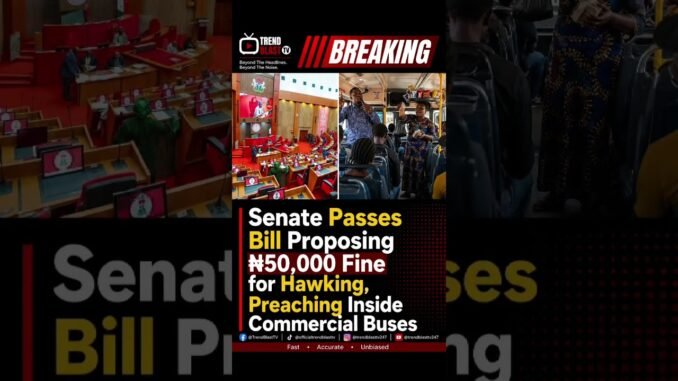

Summary: The Nigerian Senate has passed an amended FRSC bill introducing a ₦50,000 fine for hawking and preaching inside buses. Here’s a full breakdown of what the new law means for everyday Nigerians.
—
If you’ve ever boarded a Lagos danfo or an Abuja-bound luxury bus, you already know the drill — somewhere between the first and second bus stop, a hawker hops in selling groundnuts, phone chargers, or “pure water,” and not long after, someone else stands up to deliver a passionate sermon. Well, those familiar scenes may soon come with a very steep price tag.
The Nigerian Senate has passed the redrafted Federal Road Safety Corps (FRSC) Act (Amendment) Bill, 2026*, and tucked inside this new legislation is a penalty that is already generating serious buzz across the country — a *₦50,000 fine for anyone caught hawking or preaching inside commercial buses and other transit vehicles.
—
What Did the Senate Actually Pass?
The amended FRSC bill introduces a range of heavy penalties for road and transit-related infractions across Nigeria. The legislation is designed to overhaul how the Federal Road Safety Corps enforces rules not just on the highways, but also within commercial transportation spaces.
The ₦50,000 fine for hawking and preaching in buses is one of the most talked-about provisions, but it is part of a broader set of reforms aimed at improving road safety, passenger experience, and orderly transportation across the country.
—
Why Are Nigerians Reacting?
Let’s be honest — this hits differently in Nigeria.
Hawking inside buses is not just a business; for many Nigerians, it is a survival strategy. From students trying to make ends meet, to petty traders who depend on bus passengers as their daily market, the informal economy inside commercial buses is real and significant.
Similarly, preaching inside buses has long been a cultural and religious fixture of Nigerian public transport life. Many passengers have grown up with it — some find it comforting, others find it intrusive — but it has always been there.
The question many Nigerians are now asking is: Is ₦50,000 not too steep a fine for the average person? For context, that amount equals or exceeds the monthly income of many low-income earners across the country.
—
What This Means for You
Whether you are a commuter, a trader, or a commercial driver, here is how this new bill could affect your daily life:
– Hawkers who board buses to sell goods risk a ₦50,000 fine if the law is enforced
– Preachers who use commercial buses as their pulpit could face the same penalty
– Drivers and transport operators may also be held accountable for allowing such activities on their vehicles
– Commuters could see a change in the atmosphere of their daily bus rides
—
The Bigger Picture
Supporters of the bill argue that it is long overdue. They point to issues like passenger discomfort, distractions to drivers, and the security risks that can come with unregulated access to commercial vehicles.
Critics, however, are raising important questions about implementation and enforcement. Nigeria has a long history of well-intentioned legislation that struggles to translate into practical change on the ground — and with the FRSC’s current capacity, many are sceptical about how consistently this will be applied.
There are also concerns about the disproportionate impact on vulnerable and low-income Nigerians who rely on these informal activities to survive.
—
The Bill Still Needs Presidential Assent
It is worth noting that while the Senate has passed the bill, it must still go through the House of Representatives* and receive *Presidential assent before it becomes law. So for now, those groundnut sellers and bus evangelists still have a little time.
But the message from the Senate is clear — Nigeria’s transit culture is about to be regulated more strictly than ever before.
—
What do you think about this new bill? Is ₦50,000 too harsh, or is it time to bring order to our buses? Drop your thoughts in the comments below.
Follow for more news on buzzUp9ja
Be the first to comment