
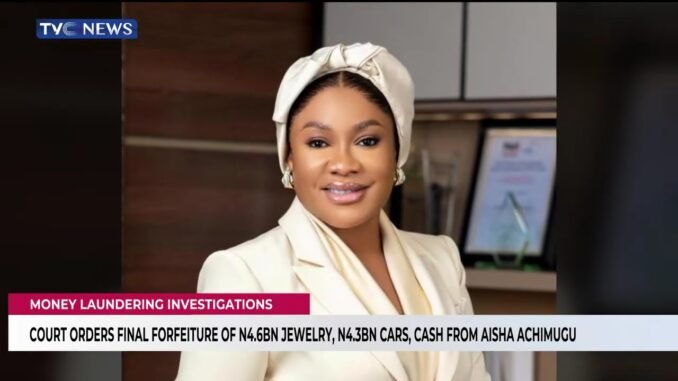

Summary: An FCT High Court in Abuja has issued a final forfeiture order on billions of naira worth of jewellery, exotic cars, and cash linked to businesswoman Aisha Achimugu. Here’s everything you need to know.
The long arm of the law has finally caught up with the assets of controversial businesswoman, Ms Aisha Achimugu, as a Federal Capital Territory (FCT) High Court sitting in Abuja has granted a final forfeiture order on a staggering collection of properties linked to her — all of which will now revert to the Federal Government.
If you thought the plot twists in your favourite Nollywood thriller were something, this real-life drama just raised the bar.
What Was Forfeited?
The court’s ruling covers an eye-watering portfolio of assets, including:
– 💎 Jewellery valued at N4.6 billion
– 🚗 Exotic cars worth N4.3 billion
– 💵 $50,000 in foreign currency
– 💰 N30,000,000 in cash
To put that in perspective — these are not your everyday Aba-market wristwatches or fairly-used Tokunbo vehicles. We are talking about the kind of opulence that makes most Nigerians’ jaws drop to the floor.
Who Is Aisha Achimugu?
Aisha Achimugu is a Nigerian businesswoman who had, until recently, enjoyed a high-profile lifestyle. She is the founder of Felicity Group, a conglomerate with interests spanning oil and gas, real estate, and other sectors. She had become something of a socialite figure — the type whose presence at events commanded attention and whose lifestyle many admired from afar.
However, her name began making headlines for far less glamorous reasons when the Economic and Financial Crimes Commission (EFCC) began trailing her over allegations of money laundering and corruption.
How Did We Get Here?
The road to this final forfeiture order has been anything but smooth. The EFCC had earlier obtained a temporary forfeiture order on the assets after convincing the court that there were reasonable grounds to believe the properties were proceeds of unlawful activity.
Following that interim order, Achimugu — like any Nigerian with billions on the line — had the opportunity to appear before the court and show cause why the assets should not be permanently seized. When the court was satisfied that no convincing legal claim was established over the assets, it proceeded to grant the final forfeiture, effectively handing everything over to the Federal Government.
Why This Matters for Nigerians
Let’s be real — many Nigerians have long grown weary of watching alleged looters flaunt obscene wealth while the rest of the country battles rising costs of living, fuel prices, and a biting economy. Cases like this, where the judiciary and anti-corruption agencies actually follow through, tend to restore a flicker of hope in the system.
This ruling sends a strong message: no matter how flashy the lifestyle, assets suspected to be proceeds of crime can — and will — be traced, frozen, and seized.
The EFCC’s Continued Push
This forfeiture is part of the EFCC’s broader crackdown on financial crimes in Nigeria. Under its current leadership, the commission has ramped up asset recovery operations, targeting individuals across various sectors — from politicians and civil servants to businesspeople and contractors.
Whether or not critics believe the EFCC is selective in its approach, rulings like this one demonstrate that the legal framework for asset recovery is functional — and increasingly being used.
What Happens to the Forfeited Assets?
By law, assets forfeited to the Federal Government are typically handed over to relevant government agencies for management or disposal. In many cases, recovered funds are meant to be channelled back into public coffers — though Nigerians will rightly ask: will these assets truly benefit the public, or will they simply disappear into another black hole?
That remains a question worth watching.
Final Thoughts
The final forfeiture of Aisha Achimugu’s N4.6 billion jewellery, N4.3 billion exotic cars, $50,000, and N30 million in cash is a significant milestone in Nigeria’s anti-corruption journey. It is a reminder that wealth acquired through questionable means is never truly secure.
As the saying goes in these streets — “Wetin man gather for darkness, court fit scatter for daylight.”
Stay tuned as this story continues to develop.
Follow us for the latest updates on court rulings, business news, and stories that matter to Nigerians.
Stay updated for more details on buzzUp9ja
Be the first to comment