
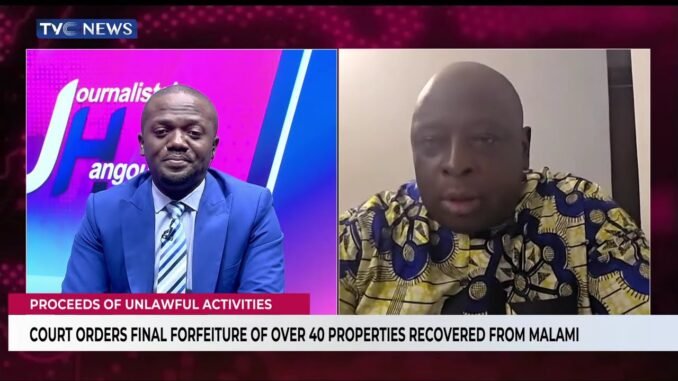

The long arm of the law has finally caught up with assets allegedly tied to former Attorney-General of the Federation, Abubakar Malami — and this time, there is no going back.
—
If you thought the Economic and Financial Crimes Commission (EFCC) was playing games, think again. In what is shaping up to be one of the most significant asset recovery victories in recent Nigerian legal history, the anti-graft agency has secured the final forfeiture of a whopping 48 properties* linked to former Attorney-General of the Federation (AGF) and Minister of Justice, *Abubakar Malami (SAN).
Yes, you read that right — 48 properties. And we are not just talking about choice plots of land or a few exotic cars. The seized assets include a full university* and a *radio station, among 46 other properties. This is big, and Nigerians deserve to know every detail.
—
Who Is Abubakar Malami?
For those who may need a quick refresher, Abubakar Malami served as Nigeria’s Attorney-General of the Federation and Minister of Justice under President Muhammadu Buhari’s administration. He was one of the most powerful figures in the Buhari government, wielding enormous legal and political influence for eight years.
However, his time in office was not without controversy. Questions about his lifestyle, assets, and alleged accumulation of wealth far beyond his legitimate earnings had been swirling long before this EFCC action landed on the front pages.
—
What Exactly Did the EFCC Seize?
The court’s final forfeiture order covers 48 properties in total, reportedly linked to the former minister. These include:
– A university
– A radio station
– 46 other properties
The sheer scale of these assets raises the kind of eyebrows that no amount of explanation can easily bring back down. For context, running a university in Nigeria is not a small-change affair — it requires billions of naira in investment. Same goes for owning and operating a licensed radio station.
The EFCC, known for its aggressive pursuit of corruption-related assets, moved through the courts to ensure these properties do not simply disappear into thin air while legal battles drag on. With a final forfeiture order now in place, the government can take full possession of these assets.
—
Why This Matters for Every Nigerian
Make no mistake — this is not just another headline to scroll past while sipping your morning kunu or tea. This development carries real weight for several reasons:
1. It sends a powerful message to public officials.
When someone who once sat at the very top of Nigeria’s legal hierarchy — the AGF, no less — has nearly 50 properties forfeited to the state, it tells every public servant that the reckoning can come for anyone.
2. It represents potential value returned to Nigerians.
These 48 properties, if properly managed by the government, represent significant economic value that could — and should — be channelled into public good. Think of the hospital that could be built, the scholarships that could be funded, or the infrastructure that could be developed.
3. It tests the integrity of Nigeria’s anti-corruption institutions.
The real question now is: what happens next? Will these assets be transparently managed and utilised for public benefit, or will they quietly find their way into the hands of another set of powerful individuals? That is the test every Nigerian must hold their leaders accountable to.
—
The EFCC’s Growing Boldness
Under its current leadership, the EFCC has shown a renewed appetite for going after high-profile targets — and not just the small fish. From politicians to businesspeople, the commission has been making moves that signal a shift in how seriously Nigeria is taking its anti-corruption mandate.
Securing a final forfeiture order for assets of this magnitude, particularly ones tied to a former minister of Malami’s stature, is a landmark achievement. It demonstrates that Nigerian courts can and do rule against the powerful when the evidence is compelling.
—
What Happens to the Properties Now?
Under Nigerian law, assets that are finally forfeited to the federal government are typically handed over to relevant government agencies for management or disposal. The EFCC often works with other bodies to ensure recovered assets are put to productive use — though transparency in this process has historically been a concern raised by civil society groups.
Nigerians and accountability watchdogs will certainly be keeping a close eye on what becomes of this university, the radio station, and the 46 other properties.
—
Final Thoughts: Justice Delayed Is Not Always Justice Denied
There is a popular saying on our streets: “E go better.” And moments like this — however imperfect the system may be — remind us that accountability, even when slow, is not entirely impossible in Nigeria.
The EFCC’s securing of final forfeiture orders on 48 properties linked to a former AGF is a bold step. But steps, no matter how bold, mean little without follow-through. The real victory will come when these recovered assets genuinely serve the Nigerian people.
Until then, we watch. We ask questions. And we hold the system accountable — because that is exactly what citizens must do.
—
Stay informed. Share this story. Nigeria deserves better, and it starts with knowing what is happening in your name.
Stay connected to buzzUp9ja for more news
Be the first to comment