
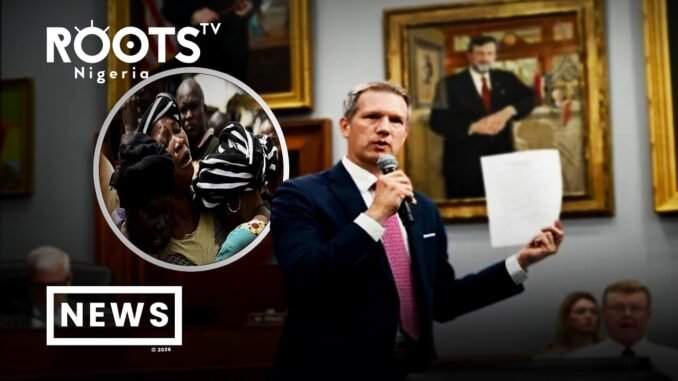

A United States Congressman has pointed fingers at Fulani militants as the primary drivers of violence against Christians in Nigeria, reigniting global conversations about the worsening security situation in the country.
What the US Lawmaker Said
American Congressman Riley Moore has made a bold claim that is sending shockwaves across both Washington and Abuja — alleging that Fulani militants are currently the largest perpetrators of violence against Christians in Nigeria.
Moore’s statement did not come out of thin air. It lands at a time when concerns about the safety of Christian communities across Nigeria’s Middle Belt and other regions have been growing louder, both locally and on the international stage.
Why This Statement Matters for Nigerians
For many Nigerians — particularly those in states like Plateau, Benue, Kaduna, and Zamfara — this is not breaking news. Communities in these areas have endured years of devastating attacks, with farmers, villagers, and worshippers falling victim to violent raids that have left trails of death, displacement, and destruction.
The fact that a sitting US lawmaker is now raising this issue at the international level signals that the world is watching — and that Nigeria’s handling of this crisis is increasingly under the microscope.
A Crisis That Has Claimed Thousands of Lives
Nigeria has long grappled with the deadly conflict between herding communities and farming settlements. However, what began as disputes over land and water has, in many cases, escalated into coordinated attacks on predominantly Christian communities.
Human rights organisations and Christian bodies, including the Christian Association of Nigeria (CAN), have repeatedly called on the Federal Government to treat these attacks with the same urgency applied to other security threats like Boko Haram and ISWAP.
The International Pressure Builds
Congressman Moore’s comments are part of a growing chorus of international voices demanding accountability. The United States Commission on International Religious Freedom (USCIRF) has, on multiple occasions, recommended that Nigeria be designated a “Country of Particular Concern” — a label that could trigger diplomatic and economic consequences.
Nigeria has consistently pushed back against such designations, with government officials arguing that the violence is more complex than a straightforward religious persecution narrative.
What Nigerians Are Saying
On social media and in households across the country, reactions have been sharply divided along familiar fault lines. Many Christians, especially from affected communities, have welcomed the international attention, expressing frustration that the Nigerian government has not done enough to protect them.
Others caution against framing what is a multidimensional security crisis purely in religious terms, warning that doing so could deepen existing fault lines in an already fragile nation.
The Bigger Picture
Nigeria remains one of the most religiously diverse nations on the African continent, home to roughly equal numbers of Christians and Muslims. The peaceful coexistence that once defined many communities is now under severe strain.
As international scrutiny intensifies, the pressure is firmly on Abuja to demonstrate that it takes the protection of all Nigerian citizens — regardless of faith or ethnicity — seriously.
The question many Nigerians are asking is simple: When will enough be enough?
This story is developing. Stay with us for updates as more details emerge.
Check buzzUp9ja for more details.
Be the first to comment