

Summary: President Tinubu directs deployment of 100,000 CNG conversion kits across Nigeria within weeks to reduce transportation costs amid rising fuel prices. Here’s what you need to know.
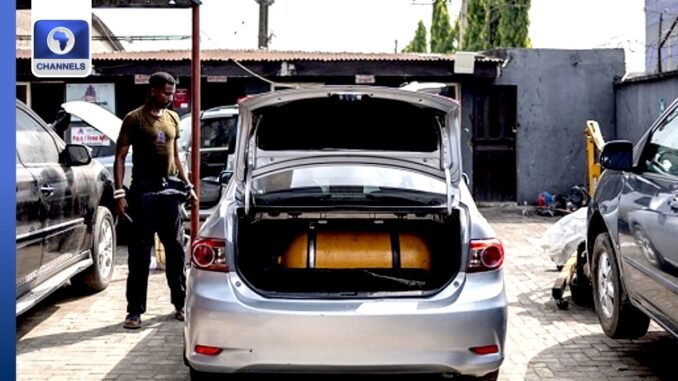
As fuel prices continue to squeeze Nigerian pockets, President Bola Tinubu has ordered the immediate nationwide distribution of approximately 100,000 compressed natural gas (CNG) conversion kits to provide relief for millions of Nigerians struggling with transportation costs.
The announcement came on Tuesday, March 10, following a crucial meeting between the President and Ismaeel Ahmed, Executive Chairman of the Presidential Initiative on Compressed Natural Gas (Pi-CNG), at the State House in Abuja.
Why Now? Middle East Crisis Worsens Fuel Situation
The timing of this intervention isn’t coincidental. With the escalating conflict between the United States, Israel, and Iran causing global oil market upheavals, fuel prices have been climbing steadily—hitting Nigerian commuters, traders, and businesses where it hurts most: their wallets.
“The President, as usual, is always trying to get information on what is going on, especially with the war in the Middle East and the rising cost of petrol and diesel,” Ahmed explained after the meeting.
President Tinubu specifically wanted updates on how Pi-CNG could scale up gas availability across the country to bring down transportation costs for everyday Nigerians.
100,000 Kits Coming in Two to Three Weeks
Here’s the timeline Nigerians should watch: Ahmed confirmed that the 100,000 conversion kits will be deployed within the next two to three weeks, transforming conversion centres nationwide into hives of activity.
“The conversion centres will all be bustling with a lot of activities,” Ahmed promised.
These kits will enable vehicle owners—including tricycle (keke) operators—to convert their petrol or diesel engines to run on cheaper, cleaner natural gas. For many Nigerians who depend on commercial transportation for their daily bread, this could mean significant savings.
Massive Infrastructure Expansion Underway
But it’s not just about the conversion kits. President Tinubu has also ordered an accelerated expansion of CNG refuelling and electric vehicle (EV) charging infrastructure across the country, with special focus on the Northern Corridor.
Ahmed revealed that 77 CNG refuelling stations are currently under development nationwide. In Kano alone, two liquefied compressed natural gas (LCNG) stations are already operational, with several “daughter stations” under construction.
The government’s ambitious plan includes creating a chain of refuelling points along major transport routes—from Lokoja through Abuja, Kaduna, Zaria, and Kano, all the way to Maiduguri.
“These are all places that we are going to litter with a lot of refuelling units,” Ahmed stated confidently.
Local Manufacturing and Job Creation on the Horizon
In what could be a major boost for Nigeria’s automotive sector, Pi-CNG is partnering with both local and foreign manufacturers to enhance vehicle conversion capabilities and promote local assembly of CNG-powered and electric vehicles.
According to Ahmed, several manufacturers have already expressed interest in establishing assembly plants in Nigeria—a development that promises job creation and economic diversification at a time when unemployment remains a national concern.
Solar-Powered Charging for Off-Grid Areas
Recognizing that many Nigerians live in areas without stable electricity, Pi-CNG is collaborating with the Rural Electrification Agency (REA) to build solar-powered EV charging stations in off-grid communities.
“People are already bringing in their electric vehicles regardless. What we have to do now is to ensure that there is enough infrastructure for them to work with, especially off-grid,” Ahmed explained.
What This Means for the Average Nigerian
For transport operators—from danfo drivers in Lagos to keke riders in Kano—the CNG conversion could slash fuel expenses by more than half. Natural gas is significantly cheaper than petrol or diesel, meaning lower operating costs and potentially lower transport fares for commuters.
For everyday Nigerians tired of watching their transport budget balloon every month, this initiative offers a glimmer of hope that relief might finally be coming.
Will It Work?
President Tinubu, according to Ahmed, expects quick results. The administration is betting that making cheaper, cleaner, and more sustainable transport options available will cushion the impact of fuel price hikes while positioning Nigeria to benefit from the global shift toward alternative energy.
Whether the infrastructure can be deployed fast enough and whether Nigerians will embrace the technology at scale remains to be seen. But with 100,000 conversion kits about to hit the streets and dozens of refuelling stations under construction, the next few months will be crucial.
For millions of Nigerians watching their transport costs climb daily, this intervention cannot come soon enough.
What do you think about the CNG initiative? Will you consider converting your vehicle? Share your thoughts in the comments below.
Stay updated on buzzUp9ja
Be the first to comment