
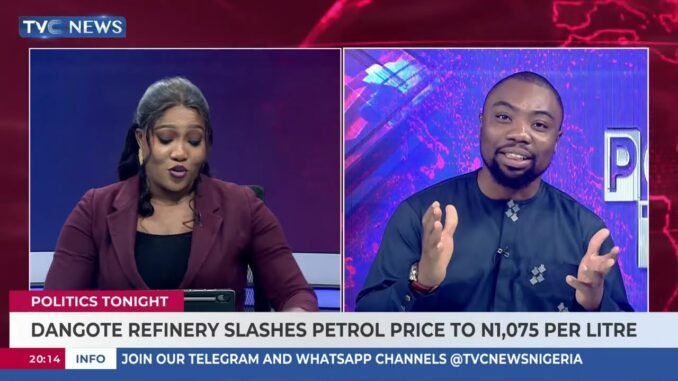

Summary: Oil marketers say Dangote Refinery has prevented petrol prices from reaching N1,500 per litre despite global oil market volatility and Middle East tensions affecting fuel costs across Nigeria.
Nigerians may have more reason to appreciate the Dangote Refinery than they realize. According to oil marketers, the country would be paying as much as N1,500 per litre for petrol today if we were still completely dependent on imported fuel.
This revelation comes as petrol prices continue to climb across the country, with many filling stations in Lagos now selling above N1,000 per litre – a significant jump from the previous average of N939 per litre just weeks ago.
How Dangote Refinery Is Saving Nigerians Money
Industry experts say that improvements in local refining capacity, particularly the operations of Aliko Dangote’s massive refinery in Lekki, have helped cushion the blow from rising global oil prices and supply chain disruptions.
Chinedu Ukadike, National Publicity Secretary of the Independent Petroleum Marketers Association of Nigeria (IPMAN), explained that while prices are still increasing, local refining has prevented a much worse situation.
“If we were still importing most of our fuel like before, the current global pressures could have pushed petrol prices to N1,500 per litre or even higher,” Ukadike stated. “We would also be experiencing severe shortages due to increased competition for supply in the international market.”
What’s Driving Current Price Increases?
Several factors are combining to push fuel prices upward:
1. Middle East Tensions
The ongoing crisis in the Middle East – one of the world’s most critical oil-producing regions – has triggered volatility in global crude oil markets. Even the fear of supply disruptions, whether or not they actually happen, can cause traders to increase prices immediately.
2. Exchange Rate Pressure
The naira’s continued weakness against the dollar means that even locally refined products are affected, as crude oil is priced in dollars on the international market.
3. Rising Global Crude Prices
Brent crude has been trading above $100 per barrel in recent weeks, directly impacting the cost of petroleum products worldwide.
4. Increased Logistics Costs
Transportation and distribution expenses have also climbed, adding to the final pump price consumers pay.
The Reality of Deregulation
The Nigerian Midstream and Downstream Petroleum Regulatory Authority (NMDPRA) has confirmed that pump price fluctuations now reflect market forces following the deregulation of Nigeria’s downstream petroleum sector.
This means the days of fixed, government-subsidized fuel prices are truly over. While this reality is painful for many Nigerians already struggling with economic hardship, marketers insist that the alternative – continued dependence on imported fuel – would have been far worse.
Addressing Claims of Price Exploitation
Some Nigerians have accused marketers of exploiting old stock purchased at lower prices. Ukadike firmly dismissed these claims.
“Price adjustments in the oil and gas sector are directly tied to the cost of crude oil and exchange rate movements,” he explained. “This is not about marketers trying to make extra profit from old stock.”
He pointed out that global fuel prices, particularly in Europe, have risen sharply in recent weeks, creating additional pressure on Nigeria’s domestic market.
Temporary Supply Concerns
Recent reports have indicated a temporary slowdown in petrol loading from the Dangote Refinery, raising concerns that pump prices could increase even further. Some filling stations in Lagos have been observed temporarily shutting down sales while awaiting new pricing decisions.
Industry operator Anwalu Ahmed confirmed that both global and domestic pressures are affecting Nigeria’s petroleum supply chain. “Even when actual supply has not been disrupted, market uncertainty alone can trigger immediate price increases,” he noted.
The Bigger Picture
While N1,000+ per litre is undoubtedly painful for Nigerian consumers, the alternative scenario painted by marketers – N1,500 per litre with widespread shortages – would have been catastrophic for the economy.
The Dangote Refinery, with its 650,000 barrels per day capacity, represents a strategic asset that is gradually reducing Nigeria’s vulnerability to international fuel market volatility.
However, challenges remain. Nigeria still relies partly on imported refined products, meaning higher landing costs whenever international crude prices rise. Full energy security will require not just refining capacity, but also stable exchange rates, improved infrastructure, and continued investment in the petroleum sector.
For now, Nigerians can take some comfort in knowing that while fuel prices are high, they could have been significantly worse without local refining capacity coming online at this critical time.
What do you think about the current fuel prices? Have you noticed the increases at your local filling station? Share your experiences in the comments below.
For more information, check buzzUp9ja
Be the first to comment