
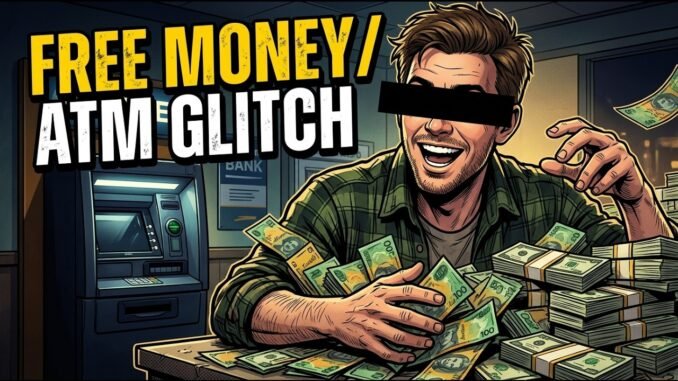

Summary: An Australian bartender discovered an ATM glitch that gave him unlimited money. He spent $1.6 million (₦1.2 billion) in just four months on a lavish lifestyle before it all came crashing down. This is his story.
Imagine waking up one day and discovering that an ATM is giving you unlimited money. What would you do? For most of us, it sounds like a dream come true – or perhaps a dangerous temptation. For Dan Saunders, an Australian bartender, this fantasy became reality in 2011, and what followed was a four-month spending spree that would change his life forever.
The Discovery That Changed Everything
Dan Saunders was just an ordinary bartender working in Wangaratta, a small town in country Victoria, Australia. Like many young Nigerians hustling to make ends meet, he was working hard, living modestly, and trying to get by. But one fateful night after finishing his shift, everything changed.
While trying to transfer money between his accounts at an ATM, Saunders stumbled upon a glitch in the bank’s system. He discovered that if he made transfers during a specific window of time – between midnight and 1 AM – the money would appear in his account immediately, but the deduction from his other account would be delayed until the system updated.
In Nigerian terms, e be like say the bank computer no dey wake up until morning, and during that time, you fit chop your money twice!
From Broke Bartender to Big Boy Overnight
What started as a small experiment quickly escalated. Saunders realized he could essentially create money out of thin air. Within days, the struggling bartender transformed into a “big boy,” living the kind of lifestyle many of us only see in music videos.
Over the next four months, Saunders spent an eye-watering $1.6 million – that’s approximately ₦1.2 billion in today’s money. For context, that’s enough to buy multiple luxury apartments in Banana Island, several Range Rovers, and still have change left over.
The Lavish Lifestyle: Living Like a Lagos Big Boy
So what does someone do with unlimited money? Saunders went absolutely wild:
– Private jet flights across Australia and international trips
– Five-star hotels and presidential suites
– Designer clothes and luxury accessories
– Expensive restaurants and bottles of premium champagne flowing like water
– Partying with celebrities and influencers
– Funding the lifestyles of friends and hangers-on
If you’ve ever watched Nigerian movies where someone suddenly comes into money and starts spraying cash at parties, buying drinks for everyone, and living recklessly – that was basically Saunders’ life. He became the ultimate “bigger boy,” the guy everyone wanted to be around.
He flew friends to different cities, bought rounds for entire clubs, and lived like there was no tomorrow. In his own words, he was treating life like “one long Lagos owambe party.”
The Psychology of Sudden Wealth
Looking back on those crazy months, Saunders has opened up about the psychology behind his decisions. At first, he convinced himself he was just “borrowing” the money. Then, as the amounts grew larger and nobody from the bank called, he started believing he’d somehow beaten the system.
“I felt invincible,” Saunders admitted. “It was like being in a dream where consequences didn’t exist.”
This mentality might sound familiar to Nigerians who’ve heard stories of yahoo boys or people who suddenly come into money through questionable means. The initial thrill, the feeling of invincibility, the belief that you’re smarter than everyone else – it’s a dangerous cocktail.
When Reality Comes Knocking
As the Yoruba proverb says, “Ojo ti a ba koju s’aye, l’aye a koju si wa” – the day we look away is the day trouble looks our way. Eventually, banks reconcile their accounts, systems get updated, and the truth always comes out.
Four months after his spending spree began, Saunders’ world came crashing down. The bank finally discovered the discrepancy, and he was arrested. The party was officially over.
He was charged with fraud and faced the very real possibility of serious prison time. All the private jets, designer clothes, and celebrity friends disappeared overnight. The people who had been happy to enjoy his “generosity” were nowhere to be found when trouble came calling – a lesson many Nigerians understand all too well.
The Consequences and Redemption
Saunders eventually pleaded guilty to dishonestly obtaining financial advantage by deception. Surprisingly, despite the massive amount involved, he received a 12-month good behavior bond rather than jail time. The judge took into account his cooperation, his genuine remorse, and the fact that he had no prior criminal record.
However, the real punishment was just beginning. Saunders was left with:
– Massive debt to repay the bank
– A criminal record
– Destroyed credit rating
– Shame and embarrassment
– Lost relationships and reputation
In his recent interviews, Saunders has been brutally honest about the experience. He’s used his story as a cautionary tale, speaking publicly about the dangers of greed, the illusion of easy money, and the psychological impact of his choices.
Lessons for Nigerians
This story resonates deeply in Nigeria, where the temptation of quick money is everywhere – from yahoo yahoo to political corruption, from betting apps promising instant riches to cryptocurrency scams.
Here are the key lessons:
1. There’s no such thing as free money. Whether it’s an ATM glitch, a “business opportunity” that sounds too good to be true, or someone promising to double your money, if it seems impossible, it probably is.
2. Your character is tested when no one is watching. Saunders could have reported the glitch immediately, but he chose not to. That choice defined everything that followed.
3. Instant gratification has long-term consequences. Four months of luxury resulted in years of debt, shame, and regret.
4. Fair-weather friends disappear when trouble comes. The people enjoying your “generosity” won’t be there to help you pay back the debt.
5. The system always catches up. Whether it’s a bank, EFCC, or karma – you cannot outrun consequences forever.
The Mental Health Angle
Saunders has also spoken about the mental health crisis that followed his arrest. The shame, depression, and anxiety were overwhelming. He struggled with suicidal thoughts and had to rebuild his entire life from scratch.
This aspect of his story is particularly important in Nigeria, where mental health is often stigmatized, and people suffering in silence is all too common. Saunders’ openness about his struggles has helped break down some of these barriers.
Where Is He Now?
Today, Dan Saunders has turned his life around. He’s paid back his debts, rebuilt his reputation, and now works as a speaker and advocate for financial literacy and mental health awareness. He uses his story to warn young people about the dangers of greed and the importance of integrity.
His journey from bartender to fraudster to reformed advocate is a powerful reminder that our worst mistakes don’t have to define us permanently – but they will always have consequences.
Final Thoughts
The story of Dan Saunders is like something out of a Nollywood movie, but it’s completely real. It’s a modern-day parable about greed, consequences, and redemption that every Nigerian – young and old – can learn from.
In a country where “hustle culture” sometimes glorifies cutting corners and getting rich by any means necessary, Saunders’ story is a stark reminder that true wealth isn’t just about money in your account. It’s about peace of mind, clear conscience, and the ability to sleep at night knowing you’ve earned what you have honestly.
As our parents would say, “Oko ti a ji kọ, kii pe lori ẹlẹdẹ” – a hoe that is stolen cannot last long on the farmer’s shoulder. Or in Nigerian Pidgin: “Wetin you steal no go last, e go wahala you reach your fourth generation.”
The ATM might have had a glitch, but Dan Saunders’ moral compass had an even bigger one. His story teaches us that the real glitch isn’t in the system – it’s in thinking we can cheat our way to happiness without paying the price.
What would you have done in his situation? Drop your comments below.
For more information, check buzzUp9ja
Be the first to comment