
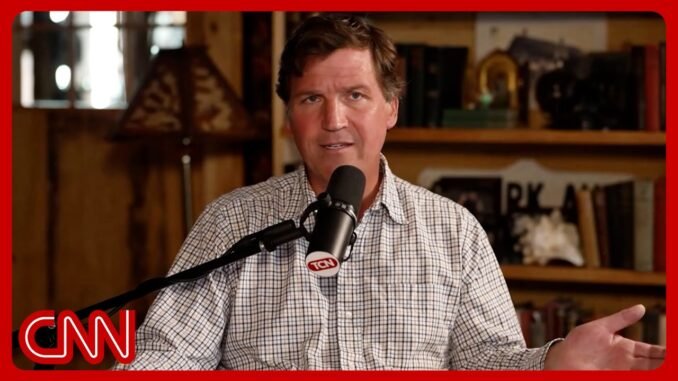

Summary: Popular American conservative commentator Tucker Carlson announces he will no longer support the Republican Party. Find out why this political heavyweight is walking away and what it signals for the future of conservative politics in America.
In a move that has sent shockwaves through American political circles, Tucker Carlson—one of the most influential conservative voices in the United States—has announced that he is cutting ties with the Republican Party. This dramatic declaration comes at a critical time, just as the country gears up for important political contests.
Who is Tucker Carlson?
For those unfamiliar with American politics, Tucker Carlson is not just any commentator. Think of him as someone similar to how influential Nigerian political analysts shape public opinion on major TV stations. Carlson has spent years as a leading voice on conservative television, commanding millions of viewers and wielding significant influence over Republican voters and politicians alike.
His nightly programme has been a must-watch for conservative Americans, much like how Nigerians tune in to programmes like “Politics Today” or “Journalists’ Hangout” to understand the political landscape. When someone of Carlson’s stature speaks, politicians listen—and voters follow.
A Shocking Political Divorce
Carlson’s announcement represents more than just personal disillusionment; it’s a potential earthquake in American conservative politics. For years, he has been among the Republican Party’s most vocal defenders, championing their causes and policies on national television. His decision to walk away is comparable to a prominent party chieftain in Nigeria suddenly denouncing their political party—it’s that significant.
The timing of this announcement is particularly noteworthy, coming as it does ahead of crucial elections. In the American system, midterm elections occur halfway through a president’s term and often serve as a referendum on the sitting administration’s performance.
What’s Driving This Split?
While the specific reasons behind Carlson’s break with the Republican Party weren’t fully detailed in the initial announcement, such high-profile departures typically signal deep dissatisfaction with a party’s direction, leadership, or principles.
This kind of political realignment isn’t entirely foreign to Nigerians. We’ve witnessed similar scenarios in our own political landscape—when influential figures like former Vice President Atiku Abubakar moved between parties, or when governors have defected from one party to another, often taking significant political capital with them.
The Broader Implications
Carlson’s departure raises several important questions:
Will his audience follow? With millions of loyal viewers who have trusted his political judgment for years, Carlson’s move could influence how ordinary conservative Americans vote—or whether they vote at all.
Is this a symptom of larger Republican problems? Just as fractures within Nigerian political parties often signal deeper organizational issues, Carlson’s exit might indicate growing discontent within conservative ranks that extends beyond one commentator’s grievances.
What does this mean for conservative media? In an era where media personalities hold enormous sway over political discourse—whether in America or Nigeria—Carlson’s independence could reshape how conservative messages are delivered and received.
A Nigerian Perspective
For Nigerian observers of international politics, this development offers fascinating insights into how political parties everywhere struggle to maintain unity and relevance. Despite our different systems—Nigeria’s multi-party democracy versus America’s two-party dominance—the challenges are remarkably similar.
Political parties in both countries must balance diverse interests, manage strong personalities, and respond to grassroots frustrations. When they fail, influential figures walk away, taking their supporters with them.
The situation also highlights how media figures have become political powerbrokers in their own right. Whether it’s Carlson in America or influential broadcasters and newspaper columnists in Nigeria, journalists who cross over into political advocacy wield tremendous power—and their allegiances matter.
What Happens Next?
Carlson’s announcement leaves many questions unanswered. Will he:
– Remain an independent conservative voice?
– Attempt to build a new political movement?
– Simply focus on commentary without party affiliation?
– Eventually return to the Republican fold?
The coming months will reveal whether this is a temporary separation or a permanent divorce. Either way, American conservative politics has been put on notice.
The Bottom Line
Tucker Carlson’s break with the Republican Party represents a significant moment in American political history. For a commentator who has spent years as one of conservatism’s most recognizable faces to walk away from the party speaks volumes about the current state of American politics.
As Nigerians watching from across the Atlantic, we see familiar patterns: political dissatisfaction, the search for authentic representation, and the tension between party loyalty and personal conviction. These are universal political challenges, transcending borders and systems of government.
Whether Carlson’s move proves to be a catalyst for broader political realignment or merely a footnote in American political history remains to be seen. But one thing is certain—when influential voices start walking away, political parties should take notice.
What do you think about this development? Does it remind you of similar situations in Nigerian politics? Share your thoughts in the comments below.
Stay connected for more updates on international politics and how global political trends might impact Nigeria and Africa at large.
For more details, check buzzUp9ja
Be the first to comment