
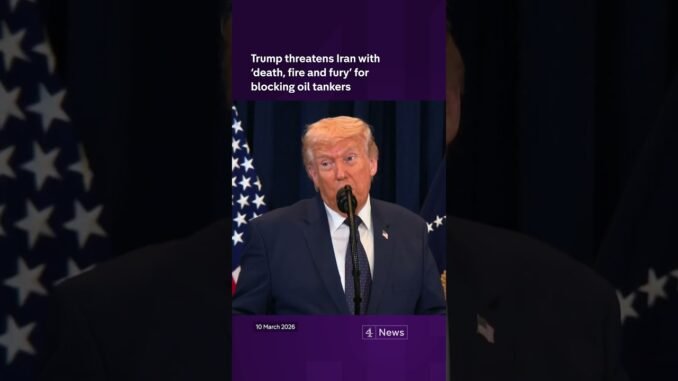

Summary: U.S. President Donald Trump has threatened severe military action against Iran if the country disrupts oil flow through the strategic Strait of Hormuz shipping route.
Former U.S. President Donald Trump has issued a stern warning to Iran regarding the security of the Strait of Hormuz, one of the world’s most critical oil shipping routes.
In a statement posted on his social media platform, Trump made it clear that the United States would respond with overwhelming force if Iran takes any action to disrupt the flow of oil through the strategic waterway.
“Twenty Times Harder” Response Threatened
Trump declared that any attempt by Iran to stop oil movement through the Strait of Hormuz would result in the country being hit “twenty times harder” than it has been in previous confrontations with the United States.
The former president went further to warn that Washington could target key Iranian infrastructure and sites that would severely hamper the nation’s ability to rebuild.
“Death, fire and fury will reign upon them,” Trump wrote in his characteristic bold language, though he added that he hopes such a drastic scenario would not come to pass.
Protecting Global Oil Supply
Trump framed his warning as a protective measure for countries that depend heavily on the Strait of Hormuz for their oil supplies. He specifically mentioned China and other nations whose energy security relies on the safe passage of oil tankers through this narrow waterway.
The Strait of Hormuz is a vital chokepoint through which approximately one-fifth of the world’s oil supply passes daily. Any disruption to shipping in this area would have immediate and severe consequences for global energy markets and prices—something that would directly affect Nigerian consumers who already grapple with fuel price fluctuations.
For Nigeria and other oil-dependent economies, stability in global shipping routes like the Strait of Hormuz remains crucial to maintaining steady energy supplies and preventing price shocks that could further strain household budgets and business operations.
The situation continues to develop as tensions between the United States and Iran remain a focal point of Middle Eastern geopolitics.
Get more details on buzzUp9ja
Be the first to comment