
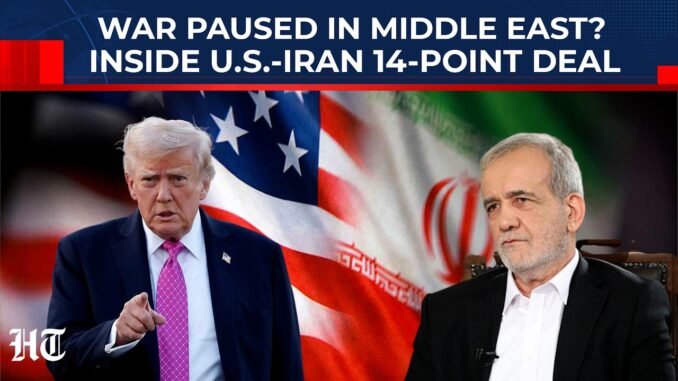

Summary: Read the complete details of the groundbreaking 14-point peace agreement signed between the United States and Iran, ending decades of tension. Find out what this means for Nigeria and the global economy.
The United States government has officially released the full text of a historic memorandum of understanding signed with Iran over the weekend, marking a potentially transformative moment in international relations.
The agreement was reached between US President Donald Trump and Iran’s President Masoud Pezeshkian, bringing hope for an end to years of military tensions and economic sanctions that have affected not just the Middle East, but global oil markets and economies worldwide—including Nigeria’s.
Why This Matters to Nigerians
For Naija people, this development is particularly significant. As Africa’s largest oil producer, Nigeria’s economy is deeply connected to global oil prices, which are heavily influenced by Middle Eastern stability. The ongoing tensions between the US and Iran have contributed to oil price volatility, affecting everything from petrol prices at Nigerian filling stations to government revenue for infrastructure development.
A stable Middle East could mean:
– More predictable global oil prices
– Reduced fuel costs for Nigerian consumers
– Better economic planning for the federal government
– Improved investment climate in the energy sector
Background to the Agreement
The relationship between America and Iran has been strained since the 1979 Iranian Revolution. Tensions escalated significantly in recent years over issues including:
– Iran’s nuclear program
– US economic sanctions
– Regional proxy conflicts
– Maritime security in the Persian Gulf
– Iran’s missile development program
The breakthrough negotiations reportedly took place over several days of intense diplomatic discussions, with both sides making significant concessions to reach common ground.
What’s in the 14-Point Agreement?
While the complete official text provides extensive details on each provision, the memorandum of understanding addresses several critical areas of contention between the two nations. The agreement is structured to create a phased approach to normalizing relations, with verification mechanisms and timelines for implementation.
Key areas covered include:
1. Nuclear Program Limitations – Restrictions on uranium enrichment and nuclear facility inspections
2. Sanctions Relief – Gradual lifting of economic sanctions affecting Iran’s oil exports and banking sector
3. Regional Security – Commitments regarding military activities in the Persian Gulf
4. Diplomatic Relations – Steps toward re-establishing formal diplomatic channels
5. Trade and Commerce – Framework for resuming bilateral trade relationships
The agreement also addresses humanitarian concerns, prisoner exchanges, and mechanisms for resolving future disputes through diplomatic channels rather than military confrontation.
Global Reactions
International leaders have responded with cautious optimism. European Union officials have welcomed the development, while regional powers like Saudi Arabia and Israel are carefully reviewing the terms.
For African nations, particularly oil-producing countries like Nigeria, Angola, and Libya, the agreement could reshape global energy dynamics and create new opportunities for cooperation.
Implementation and Verification
The memorandum establishes a joint commission to oversee implementation, with representatives from both nations and potentially international observers. Regular reporting requirements and verification protocols are built into the framework to ensure both parties honor their commitments.
What Happens Next?
The agreement now requires ratification through each country’s respective governmental processes. In the United States, this may involve Congressional review, while in Iran, the Guardian Council will need to approve the terms.
Experts suggest the implementation phase could take several months to years, depending on how quickly both sides move to fulfill their obligations under the agreement.
The Bottom Line
This 14-point agreement represents a significant diplomatic achievement that could reshape Middle Eastern politics and global economic relations for years to come. For Nigerians, the potential stabilization of oil markets and reduced global tensions could translate into tangible economic benefits.
As our leaders in Abuja monitor these developments, the hope is that reduced global tensions will create a more favorable environment for Nigeria’s economic growth and regional stability in West Africa.
What do you think about this historic agreement? How do you believe it will affect Nigeria’s economy? Share your thoughts in the comments below.
Stay tuned for updates as more details emerge about the implementation of this historic peace agreement.
Check buzzUp9ja for more news
Be the first to comment