
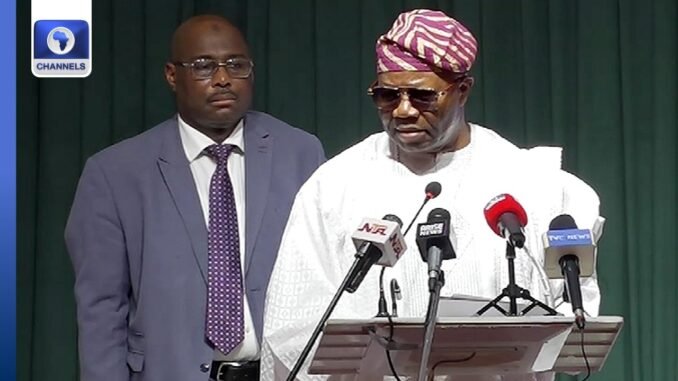

The Senate President raises alarm over alleged external funding of insecurity targeting the current administration
Senate President Godswill Akpabio has made a bold assertion that the escalating insecurity plaguing Nigeria is being deliberately sponsored by political enemies of President Bola Tinubu who are determined to undermine the nation’s democratic progress.
Speaking recently, Akpabio painted a picture of a calculated plot by opposition forces who, according to him, are uncomfortable with the current administration’s efforts to stabilize and develop the country. The Senate President’s comments have sparked fresh debate about the root causes of Nigeria’s persistent security challenges.
A Democracy Under Siege?
According to Akpabio, these unnamed adversaries are intentionally funding criminal activities and insurgent groups across the country with the singular aim of creating chaos that would discredit both President Tinubu’s government and Nigeria’s democratic system as a whole.
“Those who do not wish this democracy well are the ones sponsoring insecurity to make it look as if the government is not performing,” Akpabio stated, suggesting that the timing and intensity of recent security incidents are too coordinated to be coincidental.
The Senate President’s allegations come at a time when Nigeria continues to grapple with multiple security threats, including banditry in the Northwest, insurgency in the Northeast, separatist agitations in the Southeast, and kidnapping incidents across various regions.
Political Rhetoric or Genuine Concern?
While Akpabio’s statement reflects the government’s official position, many Nigerians have expressed mixed reactions to this narrative. Some view it as a legitimate concern about political sabotage, while others see it as an attempt to deflect responsibility for security failures.
Critics argue that attributing insecurity solely to political opposition oversimplifies a complex problem with deep socioeconomic roots, including poverty, unemployment, poor governance, and historical grievances. They contend that effective leadership requires addressing these underlying issues rather than focusing primarily on perceived enemies.
Supporters of the government, however, maintain that there is merit to Akpabio’s claims, pointing to what they describe as suspicious patterns in the timing of attacks and the sophistication of criminal operations that suggest external backing.
The Way Forward
Regardless of the politics involved, the reality remains that ordinary Nigerians continue to bear the brunt of insecurity. From farmers unable to access their lands to travelers afraid of highway bandits, and families paying ransoms for kidnapped loved ones, the human cost is undeniable.
As the debate over the causes of insecurity continues, many Nigerians are calling for concrete action rather than political blame games. They want to see improved intelligence gathering, better-equipped security forces, economic opportunities for vulnerable populations, and genuine efforts at national reconciliation.
The Tinubu administration, now well into its tenure, faces increasing pressure to demonstrate measurable progress in tackling these security challenges, whether they are politically motivated or driven by other factors.
What remains clear is that without a comprehensive approach that addresses both security operations and the underlying conditions that breed violence, Nigeria’s insecurity crisis will persist regardless of who is funding it or why.
What do you think about Akpabio’s claims? Are Nigeria’s security challenges politically motivated, or do they have deeper roots? Share your thoughts in the comments.
For more information, check buzzUp9ja
Be the first to comment