
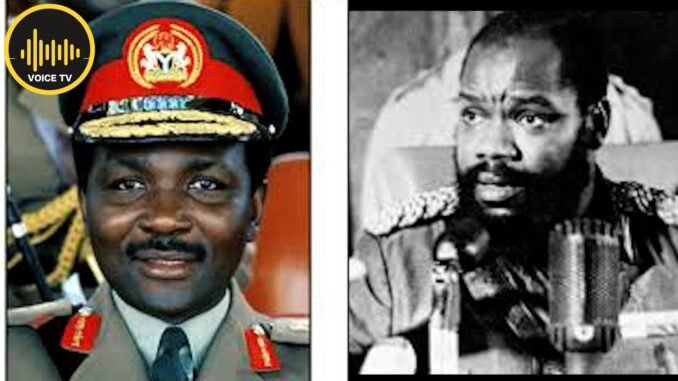

In a revealing account that sheds new light on one of the most pivotal moments in Nigerian history, former Head of State General Abdulsalami Abubakar has explained the fundamental reasons why the late Biafran leader, Emeka Odumegwu Ojukwu, refused to accept General Yakubu Gowon as Nigeria’s legitimate leader.
This refusal to recognise Gowon’s authority became one of the critical factors that escalated tensions leading to the Nigerian Civil War of 1967-1970, a conflict that remains deeply etched in the nation’s collective memory.
The Root of the Conflict
According to General Abdulsalami, the disagreement between these two military leaders went beyond mere personal differences. It touched on fundamental questions of legitimacy, military protocol, and the political future of Nigeria during one of its most turbulent periods.
The friction between Ojukwu and Gowon emerged at a time when Nigeria was grappling with ethnic tensions, political instability, and the aftermath of the January 1966 and July 1966 coups that had shaken the young nation to its core.
A Question of Seniority and Legitimacy
General Abdulsalami’s revelation provides important context for understanding why Ojukwu, then the Military Governor of the Eastern Region, took the stance he did. The issue of military hierarchy and constitutional legitimacy played crucial roles in the breakdown of relations between the two leaders.
Ojukwu’s position was not simply one of rebellion but was rooted in his interpretation of military protocol and what he considered the proper succession of leadership within Nigeria’s armed forces at that critical juncture.
Historical Significance
This disclosure by General Abdulsalami is particularly significant because it comes from someone who served in Nigeria’s military during that era and later became Head of State himself. His insider perspective offers Nigerians a clearer understanding of the complex dynamics that led to the three-year civil war.
The Nigerian Civil War, also known as the Biafran War, resulted in massive loss of life, displacement of millions, and left scars that the nation continues to heal from decades later. Understanding its origins helps current and future generations appreciate the importance of national unity and dialogue in resolving conflicts.
Lessons for Modern Nigeria
As Nigeria continues to face various challenges including ethnic tensions, agitations for self-determination in different regions, and debates about the structure of governance, the insights from General Abdulsalami serve as important reminders of how leadership disputes and questions of legitimacy can escalate into major national crises.
The relationship between Ojukwu and Gowon, and their eventual reconciliation years after the war, also offers lessons in forgiveness and nation-building that remain relevant today.
General Abdulsalami’s willingness to discuss these historical matters openly contributes to the ongoing national conversation about Nigeria’s past and how it shapes the present and future of Africa’s most populous nation.
This revelation adds another layer to our understanding of one of the most significant periods in Nigerian history, reminding us that the path to the Civil War was complex and multifaceted, involving questions of legitimacy, protocol, and leadership that went far beyond simple military rebellion.
Stay connected for more on buzzUp9ja
Be the first to comment