
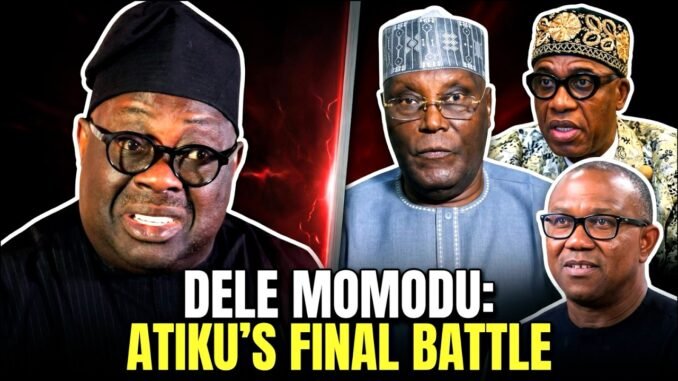

Dele Momodu, the influential publisher of Ovation Magazine and a political commentator known for never mincing words, has stirred the hornet’s nest with his latest political prediction. According to the veteran journalist, the 2027 presidential election will boil down to a straight contest between incumbent President Bola Ahmed Tinubu and perennial candidate Atiku Abubakar of the Peoples Democratic Party (PDP).
In what many observers see as a controversial take, Momodu has effectively written off Peter Obi, the Labour Party candidate who surprised many with his impressive showing in the 2023 elections, particularly among young voters and Nigeria’s social media-savvy population.
A Bold Political Forecast
Momodu’s assessment comes at a time when Nigeria’s political landscape remains as unpredictable as ever. The 2023 elections demonstrated that the old political order could be challenged, with Peter Obi’s candidacy galvanizing millions of Nigerians, especially the youth demographic who felt disconnected from traditional politics.
However, Momodu appears unconvinced that the Labour Party can replicate or improve upon its 2023 performance. His position raises several questions about the sustainability of the “Obidient” movement and whether it can transform from a protest vote into a genuine political force capable of winning Nigeria’s presidency.
The Tinubu-Atiku Narrative
By framing 2027 as a two-horse race between Tinubu and Atiku, Momodu is essentially returning to Nigeria’s familiar political script—a contest between the ruling All Progressives Congress (APC) and the main opposition PDP, with both parties’ machineries, financial war chests, and nationwide structures fully engaged.
Atiku Abubakar, the Wazirin Adamawa, has contested for Nigeria’s presidency multiple times and has indicated his continued interest in the office. Despite his advanced age—he would be 81 by 2027—Atiku remains a formidable political figure with deep pockets and extensive political networks across Nigeria’s six geopolitical zones.
President Tinubu, on the other hand, will be seeking re-election, armed with the advantages of incumbency, control of state resources, and the APC’s political machinery that has proven effective in previous elections.
What About the Obidient Movement?
Momodu’s dismissal of Peter Obi raises critical questions about the former Anambra governor’s political future and the sustainability of his support base. The 2023 elections showed that Obi could mobilize significant support, particularly in the South-East, South-South, and parts of the North-Central zones.
However, critics have long argued that the Labour Party lacks the political structure necessary to win a Nigerian presidential election. Unlike the APC and PDP, which have presence in virtually every local government area across Nigeria’s 36 states, the Labour Party’s organizational capacity remains questionable outside major urban centers.
The question becomes: Can Peter Obi and the Labour Party use the period between now and 2027 to build the political infrastructure necessary to compete effectively? Or will the movement’s momentum dissipate as economic realities and political calculations shift voter preferences?
The Reality of Nigerian Politics
Momodu’s assessment reflects a hard-nosed understanding of how Nigerian politics operates. Presidential elections in Nigeria are won not just through popular appeal but through complex negotiations, strategic alliances, financial resources, and robust party structures that can deliver votes in remote villages and urban centers alike.
The 2027 election will likely test whether Nigeria’s political culture has fundamentally changed or whether traditional political machinery still holds sway. While social media enthusiasm and youth mobilization can create impressive waves, translating that energy into actual votes across Nigeria’s diverse and sometimes difficult terrain remains a significant challenge.
A Prediction or Political Strategy?
Some observers might view Momodu’s statement as more than just political analysis. As someone with close ties to Atiku Abubakar—having even run as a presidential candidate himself under the PDP banner—his dismissal of Peter Obi could be seen as an attempt to shape the narrative and discourage Obi’s supporters.
By framing the race as exclusively between Tinubu and Atiku, Momodu might be signaling to Nigerian voters that supporting Peter Obi would be a wasted vote, thereby potentially driving some of Obi’s supporters back to what he presents as the only viable alternative to Tinubu—Atiku Abubakar.
The Long Road to 2027
While Dele Momodu has made his position clear, Nigerian politics has a way of defying predictions. The 2027 election remains years away, and much can change in Nigeria’s volatile political environment. Economic performance, security challenges, and the ability of each political camp to maintain and expand their coalitions will all play crucial roles.
For Peter Obi and the Labour Party, Momodu’s dismissal might serve as motivation to prove the doubters wrong by investing in party building, forming strategic alliances, and maintaining the enthusiasm of their support base.
For Nigerian voters, the ultimate decision will rest on their assessment of which candidate offers the best hope for addressing the country’s numerous challenges—regardless of what political pundits predict.
What remains certain is that the journey to 2027 will be filled with political intrigue, shifting alliances, and the kind of drama that makes Nigerian politics endlessly fascinating.
Stay connected on buzzUp9ja
Be the first to comment