
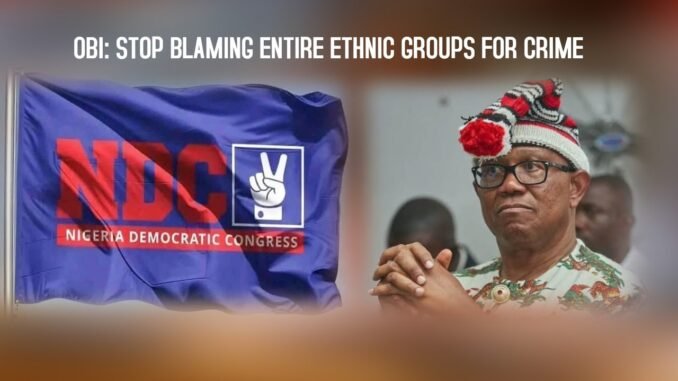

Summary: Former Anambra Governor Peter Obi speaks out against ethnic profiling of Fulani people, insisting that criminality should not be attributed to any ethnic group in Nigeria.
The 2023 Labour Party presidential candidate, Peter Obi, has raised his voice against the growing trend of associating criminal activities with specific ethnic groups in Nigeria, particularly the Fulani community.
In a statement that has sparked conversations across the nation, the former Anambra State Governor emphasized that crime is a universal problem that transcends ethnic boundaries and should never be used as a tool for division.
“Criminality Knows No Tribe”
Peter Obi’s message comes at a time when Nigeria continues to grapple with various security challenges, including banditry, kidnapping, and farmer-herder clashes that have sometimes been unfairly attributed to entire ethnic communities.
“We must resist the temptation to profile any ethnic group as criminals,” Obi stated. “Crime is committed by individuals, not by entire ethnic nationalities. When we begin to criminalize a whole people based on the actions of a few bad elements, we are setting ourselves up for deeper division and conflict.”
The Danger of Ethnic Profiling
The former governor’s stance addresses a sensitive issue that has often dominated discussions on social media and in local communities. In recent years, security challenges in different parts of Nigeria have sometimes led to blanket accusations against the Fulani ethnic group, particularly in relation to herder-farmer conflicts and kidnapping incidents.
Obi warned that such generalizations are not only unfair but also dangerous to Nigeria’s fragile unity. “Every ethnic group in Nigeria has good and bad people. The Igbos have criminals, the Yorubas have criminals, the Hausas have criminals, and yes, the Fulanis have criminals too. But that doesn’t make the entire group criminal,” he explained.
A Call for Justice, Not Stereotypes
Rather than focusing on ethnicity, the Labour Party chieftain called for a more effective justice system that targets criminals regardless of their background. He stressed that law enforcement agencies must pursue and prosecute offenders based on their individual crimes, not their ethnic identity.
“What Nigeria needs is a functional security and justice system that apprehends criminals and brings them to book, irrespective of who they are or where they come from,” Obi noted. “We must deal with crime as crime, and criminals as criminals — nothing more, nothing less.”
Building Bridges, Not Walls
Peter Obi’s statement also highlighted the importance of building bridges across Nigeria’s diverse ethnic landscape. He reminded Nigerians that the country’s strength lies in its diversity and that unity remains the only path to sustainable development and progress.
“Our diversity is our strength, not our weakness,” he said. “We must learn to see ourselves as Nigerians first before anything else. Only then can we truly tackle the challenges facing our nation.”
Mixed Reactions from Nigerians
As expected, Obi’s statement has generated varied reactions across different quarters. While many Nigerians have commended him for speaking up against ethnic profiling and promoting national unity, others have argued that the security situation requires frank discussions about the patterns of certain crimes.
However, supporters of his position maintain that stereotyping and ethnic profiling only deepen existing divides and make it harder to address the root causes of insecurity in Nigeria.
The Bigger Picture
This isn’t the first time Peter Obi has spoken out on issues affecting national cohesion. Throughout his political career, he has consistently advocated for a Nigeria where merit, justice, and fairness supersede ethnic and religious considerations.
His latest statement serves as a reminder that in confronting Nigeria’s security challenges, the focus should remain on addressing criminality through proper security architecture and justice system reforms, rather than scapegoating entire communities.
As Nigeria continues to navigate its complex security landscape, voices like Obi’s calling for unity and fairness remain crucial in preventing the country from sliding further into ethnic tensions that could have far-reaching consequences for peace and development.
What do you think about Peter Obi’s stance? Should ethnicity play any role in how we discuss crime and security in Nigeria? Share your thoughts in the comments below.
For more information, check buzzUp9ja
Be the first to comment